Feast of the Dedication of the Lateran Basilica in Rome
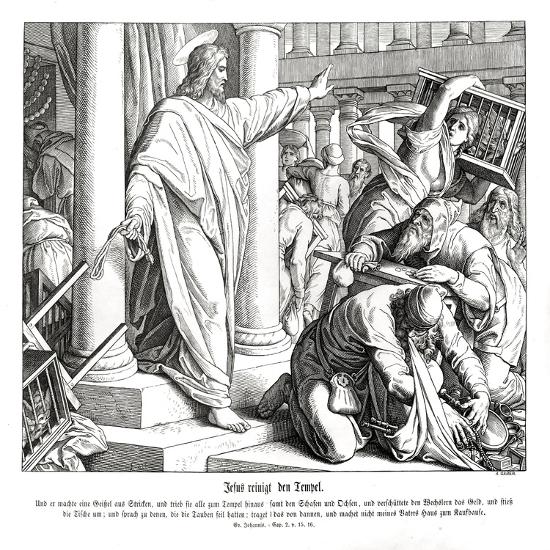
Mark was the first to write a narrative of “the cleansing of the Temple.” He places the incident after the “triumphal entry” of Jesus into Jerusalem. Matthew & Luke follow suit.
Scholars contend that these events put a target on Jesus’ back.
Jerusalem is a tinderbox on important Jewish feasts like Passover and Jesus had just struck a match in the Temple incident.
It was the responsibility of the Jewish high priest, in this case Caiaphas, to alert the Roman authorities if there was a troublemaker making noise.
Sadducees like Caiaphas walked on eggshells, knowing what Rome was capable of if there was a riot. And procurator Pontius Pilate, with a reputation of absolute ruthlessness, would “take no prisoners.” Pilate disdained the Jews on a level far beyond hate. Tiberius would eventually remove him as procurator of Judea because of his many atrocities against the Jews.
We have come to call the incident in the temple its “cleansing.” Scholars contend that it is as historical an event as anything in the Gospels. But is “cleansing” really what Jesus wanted to do?
Some suggest that he was symbolically eliminating the Temple and replacing it with the Kingdom of God. The Jesus movement was all about God’s reign. “The Kingdom of God is within you.” Why need a Temple then?
Today we hear John’s version of the Temple incident and he places it not in Holy Week but rather at the very start of the Lord’s ministry.
A generation prior to John’s Gospel, Paul wrote to the People of God at Corinth: “You are God’s building.” And our foundation is Jesus Christ. Apt words for Catholics these days in our time of closings and mergers of parishes, churches, and schools. And even Dioceses.
Feelings are facts. Grief and loss are real. Heartbreak, too. The destruction of the magnificent wonder-of-the-world Jerusalem Temple by Titus and his legions in 70 CE had the weight of a thousand nuclear explosions. Still the faithful Jewish people continued on. And so will we once the dust is settled.
For Christ is our foundation and we are the temple.
-Timothy J. Cronin
Tuesday of the Thirty-second Week in Ordinary Time
In today’s Gospel, Jesus provides the apostles with an instruction that I often need to be reminded of – serve God and never allow yourself to feel as if God owes you something in return. As someone whose profession is ministry I often find myself pleading with God, “I have given so much” or “I am on my last thread” can I not get just some time to rest and recharge?
Monday of the Thirty-second Week in Ordinary Time
Today Jesus challenges the apostles to have faith the size of a mustard seed. Earlier in Luke, in a parable, the Lord compares the same miniscule seed to the Kingdom of God. What’s all this about mustard seeds?
Saturday of the Thirty-first Week in Ordinary Time
As I read today readings, the word empower caught my attention. This is probably because I have had the opportunity to work with an international organization (Global Brigades) that strives to empower small resource limited communities in Central America. These communities become “empowered” when over the course of time, college students, community members and the Global Brigades staff collaborate until these communities can develop the necessary resources and capabilities to thrive without the assistance of outside sources. St. Paul in today’s reading explains how he is empowered by Christ to do all that he is called to do. How are we called to be empowered by Christ in both the small and large matters of our lives?
Memorial of Saint Charles Borromeo, Bishop
Death is on my mind. Although writing this reflection for Friday’s readings, I am actually writing and typing this on Wednesday, All Souls’ Day. Not only that, but I learned a few days ago that a friend and choir member from a previous parish, younger than myself, died after a short stay in the hospital; she lived most of her life in a wheelchair with others caring for her bodily needs. On top of that, my sister was recently told she has cancer, something that both of my sisters have previously battled. While at the same time, my aging father struggles to walk, and my mother struggles to breathe. Our bodies are limited; we are all mortal. Yet I am reminded today in Paul’s letter to the Philippians of our hope in the Resurrection of the Body. Not just the soul.
Thursday of the Thirty-first Week in Ordinary Time
When I was about twelve or thirteen years old, I lost my pet rabbit, Penelope. I went to feed her in her hutch out back and found the door broken and Penelope missing. I loved that rabbit, and I was very worried and upset. There were some woods near our house and I feared the worst for her. I went out looking for her and calling her, and I got my parents’ help, especially when the sun began to set. My Dad and I took a flashlight and looked some more. We didn’t find her that night or the next, or the weeks after that I kept looking for her. I cried myself to sleep many a night, worried about her out in the cold and dark, lost and afraid, maybe even hurt or worse. My parents offered to get me another bunny, but of course I didn’t want another one; I wanted Penelope.
The Commemoration of All the Faithful Departed (All Souls)
Yesterday, we celebrated with the Church Triumphant, all the saints who have entered the glory of heaven. Today, we, the Church Militant, have the privilege, honor, and opportunity to pray for the souls who experience the purifying suffering of Purgatory, awaiting the day when they will be joined with the company of saints in the unending heavenly celebration. Today is a beautiful reminder that the Body of Christ manifests herself as Church Triumphant, Militant, and Suffering. Today let us in full hope and confidence in God’s love and mercy, pray fervently for all the souls in Purgatory.
Solemnity of All Saints
One of the chaplains with whom I minister, worked especially hard on one of the bigger team efforts of our year. Her generosity was truly a labor of love that inspired me. In thanking her I remarked that she was a saint. Although my coworker did not readily accept what I meant as a complement, My explanation was that her energy was clearly that of a saint in the making. This is the universal call to holiness, that like the saints before us, we are all striving for sanctity on earth.

Monday of the Thirty-first Week in Ordinary Time
Last Halloween I saw Abraham Lincoln and the Bride of Frankenstein riding scooters around UD. The Catwoman rang me up at Krogers while Fidel Castro bagged groceries. At dusk, haunting for tricks or treats in our neighborhood were Casper the Friendly Ghost and Mr. Potato Head. Three girls came to our door all decked out as the City of New Orleans.
Saturday of the Thirtieth Week in Ordinary Time
Today’s gospel brings us to the table with Jesus, but not just any table. The table of one of the leading Pharisees. The translation we are given to read says those invited were “observing him carefully.” But I think we can imagine them judging him quietly or waiting for a mistake as the Pharisees and their stringent followers were known to do. However, at this table, Jesus teaches us all a very important lesson about our true place among one another.
Feast of Saints Simon and Jude, Apostles
Today, as we celebrate the feasts of the apostles Simon and Jude, our readings speak loudly about our call to discipleship and our membership in the communion of saints. I have been a member of many teams, organizations, groups, clubs, and communities throughout my life, all having shaped and formed me in various ways. Many of these groups were/are steeped in tradition and rich history. For instance, I work at a Catholic school that has served the Dayton community for nearly 175 years and is rooted in the charisms of two religious orders who passionately serve others in an effort to bring Christ to the world (the Marianists) and proclaim God’s goodness (the Sisters of Notre Dame de Namur). As an organization, we stand on the foundation of the mission, the vision, and the wisdom of our founders, particularly St. Julie Billiart–foundress of the SNDdeN, and Blessed William Joseph Chaminade–founder of the Society of Mary.
Thursday of the Thirtieth Week in Ordinary Time
Since the 16th century, Bible scholars have doubted that this letter was written by Paul. They can see in the writing evidence that it was written after Paul’s death. Still, it’s a letter written by someone who knew Paul and his theology very well. Since the voice of the letter is “Paul,” I’ll refer to him as if he were the author.
Wednesday of the Thirtieth Week in Ordinary Time
Our families afford us wonderful opportunities to practice Christian discipleship! Our family members constantly observe the extent to which we model God’s love and seek to follow Christ’s example. The home becomes a learning laboratory for relationships, indeed might I say that how we relate to people in general is forged in the fire of the nuclear family. Our relationships with family members both near and extended are truly foundational to all our relationships. Honestly, often our relationships with family members can be the most difficult. We struggle to understand each other, we rub each other the wrong way, differing opinions or worldviews lead to conflict, we push each other’s buttons, we take out our pain, frustration, or disappointment on each other, we have high expectations that others will meet our needs, we can be critical and demanding or experience others that way, sometimes we just take each other for granted. Today is a great day to focus on our familial relationships and to seek the grace we need to love our family members a bit more perfectly.
Tuesday of the Thirtieth Week in Ordinary Time
It’s hard to imagine that someone in our society would experience too much love. Perhaps those introverts, like myself, might easily become overwhelmed by too much attention – but even admitting that fact it seems obvious that our society cold use more love in general. Today’s first reading calls on those in married relationships to use their love in a way that models it for all of society – married or not.
Monday of the Thirtieth Week in Ordinary Time
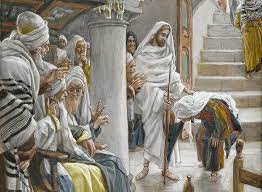
She was crippled and bent, robbed of her dignity and her rightful place in community. Unable to stand up straight, all she could see was the ground. After eighteen years, this daughter of Israel could hardly remember any other way of encountering the world.
Saturday of the Twenty-ninth Week in Ordinary Time
As a pediatrician, I spent a great deal of my training and professional career studying the human body and its development. From infancy until adulthood, there are many changes that occur. In order for this transformation to occur, there are many parts of the body that need to work together to bring about this growth. St. Paul uses the example of the human body to illustrate how the body of Christ (the church) grows into its maturity. Just like the human body, there are many parts that are necessary to build the Body of Christ, and it is God’s grace that provides the necessary energy to fuel this creation.
Friday of the Twenty-ninth Week in Ordinary Time
One of my favorites, today’s Responsorial Psalm, “Lord, this is the people that longs to see your face” is a prayer that has resonated with me for years. But today as I reflect on the readings, I find myself challenged with the question, Do I really long to see God’s face? My first reply is “yes, I do!” But with deeper reflection I find myself wondering how often I (or we) have seen God’s face and not even realized it? Or worse yet, seen God’s face and turned away?
Thursday of the Twenty-ninth Week in Ordinary Time
Today’s readings make an interesting pair. Whereas the passage from Ephesians seems uplifting, the gospel reading from Luke might be one we’d rather forget. And yet both of these texts are a part of our tradition, and they are not contradictory but rather complementary.
Memorial of Saints John de Brébeuf and Isaac Jogues, Priests, and Companions, Martyrs
Whenever I read today’s Gospel, Luke 12: 39 – 48 one word comes to mind – integrity. What is integrity? Some say it’s “doing the right thing when no one is looking”, “adhering to a strong moral and ethical code” or “always behaving according to the moral principles you believe in.” But what does all of that really mean? I like to think of integrity as “doing what is right over what is convenient.”
Feast of Saint Luke, evangelist
We learn in today’s first reading that St. Paul had one companion on the trip that would end his earthly life – Luke (2 Tm 4:11). Others have deserted him on his way to Rome because they are “enamored of the present world.” Yet, Luke accompanies him.