Wednesday of the Fourteenth Week in Ordinary Time
“Simon who is called Peter, and Andrew his brother, and James the son of Zebedee and John, his brother, Philip and Bartholomew, Thomas and Matthew the tax-collector, James son of Alpheus and Thaddeus, Simon the Zealot, and Judas Iscariot who betrayed him” (Matthew 10:2-4).
These are the Twelve. Also called Apostles, Fishers of Men, and the foundation stones of the church. It was to them that Jesus gave the great commission to take the Gospel to the ends of the earth. Catholics, Orthodox, and Anglicans claim them as the first of what today we would call “bishops.” Denominations throughout the world identify themselves as “apostolic”---as rooted in the apostles.
The Book of Revelation features them majestically enthroned around God in the heavenly throne room. All are commemorated on our liturgical calendar with a solemnity, a distinction higher than a feast or a memorial. Countless millions cannot name twelve emperors, twelve presidents, or twelve scientists. But countless millions can name these guys from the back country of the Galilee.
Here are applicable descriptors of the Twelve garnered from their interactions with Jesus, in particular in the first two Gospels, Mark & Matthew: mundane, prejudiced, unsteady, intense, foolish, skeptical, inattentive, gruff, slow-on-the-take, impatient, uncouth, forgetful, inconsistent, ill tempered, ignorant, self-centered, dense, hyper, ordinary, thick, confused, illiterate, cowardly, and impulsive. And that's on a good day!
In fact the Twelve come off so poorly that Luke in particular goes out of his way to recast them in a more proper light. But the damage to their reputations had already been done.
One of them, Matthew, was in cahoots with the foreign occupiers and a traitor to his people. Another, Simon Zealots, was a fanatical sicarii promoting violent overthrow of those same occupiers. A third, Peter, kept a sword hidden in his clock “just in case.” Nathaniel wrote off anyone from Nazareth. Hot headed James and John urged Jesus to cast fire from the sky to consume an unwelcoming village to a crisp. And Thomas put a damper on Easter itself.
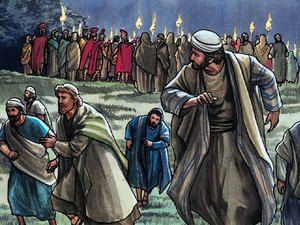
The Gospel of Mark pictures all twelve as unable to understand a single thing Jesus does or says. And not even Jesse Owens could out pace the scampering twelve as they bolted out of Gethsemane upon Jesus's arrest, record breaking in their abilities to race, dart, and scurry.
As my mother would say of such hard-to-get-to individuals as they, “Christ on the cross wouldn’t please them!”
Really, Jesus? Why this ragtag ill suited bunch of ruffians not up for the task? Was there a miscalculation or a mistake? Didn't HR send along their references, psychological evaluations, curriculum vitae? Today, no bishop or seminary on earth would accept this lot as candidates. These are the best you can do?
Doubters, betrayers, and deniers. Baffling.
But in all honesty, don't they sound a lot like anybody else you know? Aren’t we similar to those pre-Easter apostles from time to time?
Jesus did not ask the Twelve for their references, look at their SAT scores, or scrutinize their resumes. Not exactly the crème de la creme, they didn’t volunteer for the job; He chose them for the job.
The number twelve evoked the early experience of Israel. After their liberation from Egypt and return to the Promised Land, the twelve tribes, each descended from one of the twelve patriarchs (sons of Jacob), formed a confederacy.
“Jesus then sent them out. He instructed them, 'Do not follow the road to Gentile territory; and do not go into a Samaritan town. Rather, go to the lost sheep of the House of Israel'” (Matthew 1:5-7).
Southern Galilee, to which they were sent, covered an area about twenty-five miles long by about twenty five miles wide. There were about two hundred small towns and villages in the area, none far from its neighbor.
Within Jewish culture, the number twelve represented totality. In sending twelve, Jesus was sending all. The emphasis on the Twelve would seem to indicate the early Christian community’s conviction that, as followers of Jesus who fulfilled the law and the prophets, they were the authentic Israel.
And Israel, like us, was no plumb to be picked from the tree of perfection.
If the Lord can work wonders with the likes of these, imagine what he can do with the likes of us! There’s hope to be had here.
Holy apostles, pray for us!
-Timothy J. Cronin