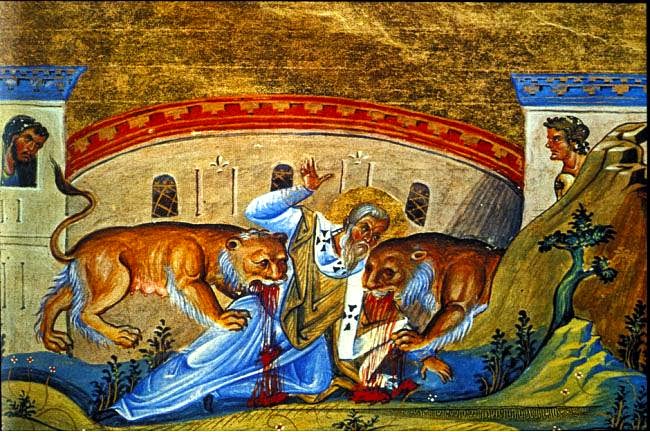
Memorial of Saint Ignatius of Antioch, Bishop and Martyr
Challenging attitudes toward “stuff” is an important theme in Luke/Acts and is front and center in today’s parable.
Memorial of Saint Teresa of Jesus, Virgin and Doctor of the Church
Let's be honest: when someone doesn’t pay attention to you, it can drive one mad. That feeling of being invisible, insignificant, unworthy of someone’s time. Even in the smallest of circumstances, I know it causes me to question the person who cannot be present with me. What do they have better to do or think about? Are they my true friend in this moment? Do they value me or care about me at all?
Friday of the Twenty-eighth Week in Ordinary Time
A quick read of the gospel today could easily cause some confusion. Jesus sounds mighty contradictory: “Do not be afraid (4)…be afraid (5)…be afraid (5 again)…do not be afraid (7)”. What?!? The dictionary definition of fear is something akin to an unpleasant emotion caused by the belief that someone or something is dangerous, likely to cause pain, or a threat. Christ is drawing a contrast between two different kinds of fear. The first is a misguided fear; the second is a healthy fear.
Thursday of the Twenty-eighth Week in Ordinary Time
There is a lot of enthusiasm these days, within and beyond the Catholic Church, for a Calvinist understanding of salvation. According to that view, God determined before the beginning of time who is saved and who is damned. The thinking behind this theology of salvation is that we humans can do absolutely nothing to gain God’s grace. Who is saved and who is damned is absolutely up to God. We play no role in our own salvation.
Wednesday of the Twenty-eighth Week in Ordinary Time
I invite you to sit for a minute and ponder this question - what controls you - your body or your spirit? When you honestly sit down and look at the decisions you made today, when you think about your thoughts, words, and actions, do you find you were driven by the spirit or by a desire to meet the needs of your temporal body?
Tuesday of the Twenty-eighth Week in Ordinary Time
Before I met Joel and married him, I remember my mom worrying that I was trying too hard to make people like me. "Love has to just flow," she'd tell me. And in trying too hard, I'd try to be someone I wasn't - and the potential suitor would be pushed away by my inauthenticity. It happened a couple times before I realized I really did have to "be myself". (Harder to do than it is to say!)
Monday of the Twenty-eighth Week in Ordinary Time
The word “sign” is preeminent in Luke’s Gospel today. Life is full of signs: signs advertising products, traffic signs. The sacraments are signs. People reveal likes or dislikes through the signs of body language. It is essential to pay attention to both material and spiritual signs and even dangerous sometimes not to do so.
Saturday of the Twenty-seventh Week in Ordinary Time
It has been a standing joke in our family that when someone asks what I want for my birthday, I respond by saying, ”I just want everyone to get along and be happy.” Everyone usually just laughs at my response, since this seems like an implausible goal. I think that this desire for peace and unity comes from deep within. God has created all and draws all to be one in Christ as St. Paul mentions in his letter to the Galatians. The readings today offer some insights on the ways we might begin to move towards this remarkable experience of harmony and peace.
Memorial of Our Lady of the Rosary
I might not have thought so as a teen, but I am thankful my parents chose for me the middle name of Mary. Mary, as in “Our Lady” the Mother of God. I now see it as an honor, one that perhaps forged a special connection that never completely went away (although it lay dormant for a period of time before having children of my own.) Mary, who is liturgically remembered on this date as “Our Lady of the Rosary.” I confess I do not regularly pray the rosary, but I appreciate what Pope John Paul II wrote about it in his apostolic letter on the Rosary, twenty years ago this month.
Thursday of the Twenty-seventh Week in Ordinary Time
While strolling through the student neighborhood near the University of Dayton (UD) campus, I noticed the father (presumably) of a student placing groceries on his son or daughter’s front porch. I could tell he had already made a few trips back and forth from his car. On the steps sat large packages of chicken, bags of charcoal, several two-liter bottles of beverages, chips, salsa, and bottles of BBQ sauce. I surmised that not only was this dad preparing to cook for his son or daughter in celebration of Parent’s Weekend, but he planned to include several of their friends, too.
Wednesday of the Twenty-seventh Week in Ordinary Time
Scripture Readings
In today’s Gospel Jesus’ disciples are earnestly trying to follow him correctly. They want to be taught how to pray. Jesus responds with “When you pray, say:
Memorial of Saint Francis of Assisi
I’ve often found that during those times when I am the busiest I have a tendency to falter in my relationship with God. I find myself spending less time in prayer and putting less effort into considering what God would have me do, think, and will. Nevertheless, having nothing to do is also not very conducive to my spiritual life. Being not busy enough can result in boredom and lack of purpose. What is best seems to be a balance between being too busy and not busy enough.
Monday of the Twenty-seventh Week in Ordinary Time
“If I were trying to please people, I would not be the servant of Jesus Christ” (Galatians 1:10).
“You can please all of the people some of the time, or some of the people all of the time, but you can’t please all of the people all of the time.”
Memorial of Saint Thérèse of the Child Jesus, Virgin and Doctor of the Church
Today the first reading is taken from the final lines of the book of Job. Now, I have quite the personal connection with Job - that is, our names are very close in spelling. But on a deeper note, we all have a connection to our main character in a way.
Memorial of Saint Jerome, Priest and Doctor of the Church
Today is the feast of St. Jerome. I admittedly know little about him other than the fact that he is a doctor of the church and was most well-known for producing a new translation of the bible. In reading a little more about him, I came across a quote attributed to St. Jerome: "I interpret as I should, following the command of Christ: 'Search the Scriptures,' and 'Seek and you shall find.' For if, as Paul says, Christ is the power of God and the wisdom of God, and if the man who does not know Scripture does not know the power and wisdom of God, then ignorance of Scriptures is ignorance of Christ." I find his reflection fascinatingly similar to the message of Jesus today in the gospel. “Whoever listens to you listens to me. Whoever rejects you rejects me. And whoever rejects me rejects the one who sent me.” (Lk 10:16) What a poignant call to discipleship. We are invited into relationship with our good and glorious God. Our relationship with one another should reflect our relationship with Christ.
Feast of Saints Michael, Gabriel, and Raphael, archangels
Before us today in the Gospel reading are three very interesting figures. Three figures we can learn from.
First, there is Phillip. “Follow me,” Jesus commands. And Phillip does. That sounds so simple. Jesus is the Messiah. The Son of God. King of Israel. The Lamb of God. Rabbi. Phillip got all this. So, when Jesus hailed him, he followed.
Wednesday of the Twenty-sixth Week in Ordinary Time
If you’re a parent, you know that the worst part of going to the park (or anywhere fun) is leaving the park to go home. On a good day I can offer a 5-minute warning, let them know when it’s time to choose one more thing and then announce that it’s time to go home and all four of my children will obediently walk to the car. But who am I kidding? A typical trip to the park ends with them pretending not to hear me, bargaining for more time, pleading for one more chance to swing on the swings or stubbornly deciding they need to go down the slide just one last time.
Memorial of Saint Vincent de Paul, Priest
Sometimes it seems like there’s no clear reason for our lives. We may feel useless and our daily toil and worry seems to be of no avail. At such times life can appear to be meaningless and without purpose. As the writer of Ecclesiates writes: “Vanity of vanities, says Qoheleth, vanity of vanities! All things are vanity! What profit has man from all the labor which he toils at under the sun?” (Ecclesiastes 1: 2-3). Perhaps, like Job, we even curse the day we were born, thinking it better if we had never existed (Job 3: 1-15). But even if we don’t go that far, we can sometimes wonder why we bother getting out of bed in the morning. Wouldn’t it just be easier to sleep all day – to “drop out” of our busy lives? This is not even to mention the fact that good people seem to suffer and those who do great injustice to others often seem to escape without punishment or even seem to prosper.
Monday of the Twenty-sixth Week in Ordinary Time
“Mirror, mirror on the wall. Who’s the fairest of them all?”
If martians were monitoring us exclusively through our media they would have a disoriented image of earthlings. They might say upon visiting earth, “We’ve been duped! Not all earthlings are successful, influential, or beautiful!”
Memorial of Saint Pius of Pietrelcina, Priest
In a recent article about the “nones” in our society, I was struck by a comment that mentioned one of the reasons that some were leaving religion was because they felt that life was good, and therefore there was no need to believe in a higher power. Both of today’s readings remind us that there will be both times of blessings and difficulties as part of living. If we live our lives rooted in gratitude and trust in God, then we will be able to navigate the ups and downs of daily life and be a witness to the world around us.