Feast of the Transfiguration of the Lord
There have been many books released in the past couple years that proclaim "the God delusion," that "God is not great," and that Jesus must be some kind of strange myth dreamed up by those who want power. Under the guise of reason these books put forth arguments that are very tempting for our day, and that are not all that new. People have been discussing modern atheism and questioning God's existence for the past two centuries, but as today's letter from Peter (2 Peter 1:16-19) attests, people have been directly questioning who Jesus is ("cleverly devised myths") ever since he died and rose again. On this feast of the Transfiguration, which is a feast celebrating that Jesus is revealed as divine and human to us mere creatures, the scriptures have much to say to us about modern-day and historic atheism.
Friday of the Eighteenth Week in Ordinary Time
Denied! To contradict; repudiate; declare untrue; refute; contest; oppose; reject; decline; turn down; veto. There are many ways to interpret and use the concept of denial. By definition, to deny is to state that one refuses to admit the truth or existence of. We have entered the month of August and I know a lot of students and teachers who are in denial about going back to school soon. How many of us have been in denial about some impending appointment, situation, or the result of an event? Some of us are in denial about the fact that we are getting older. Heck, I confess that, earlier this week, I was in denial about the fact that I needed to write a reflection for today. But in today’s gospel, Jesus is talking about a different kind of denial.
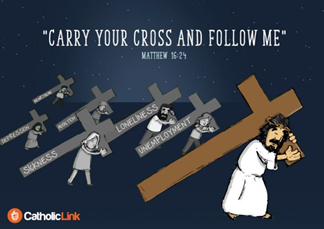
“Whoever wishes to come after me must deny himself,
take up his cross, and follow me.
For whoever wishes to save his life will lose it,
but whoever loses his life for my sake will find it.” (Mt 16:24-25)
An alternative definition for deny is to give or grant something to someone or, similarly, to refrain from satisfying oneself. We had movie night earlier this week with our kids and watched a newer animated film called The Bad Guys, a movie about some stereotypically villainous characters–a wolf, a snake, a shark, a tarantula, and a piranha–attempting to become good guys. In the movie, there is a beautiful scene (to me at least) where one of the characters defines goodness as “putting the needs of someone else before yourself”. It was a striking reflection of Christ’s message today.
Our Lord invites us to let go of our ego and enter into God’s story. Our lives, our actions, our decisions, and our freedom are best understood in relation to others. We are invited into something greater than ourselves. I often need a reminder that I was created in the image and likeness of God, not the other way around. How often do we trap ourselves in the chains of judgment, pride, and selfishness? At times, I catch myself wallowing in pity and self-loathing about some minor problem or stressor. Life often presents us with a variety of burdens (crosses), some more difficult than others. It’s not easy to accept the weight of the cross bearing down–illness, finances, family challenges, depression, addiction, joblessness, loss. Jesus invites us to bring those crosses to him. Are we willing to pick it up and bring it along?
A reality of life is that it will involve some sort of suffering as much as it will produce joy, love, peace, and comfort. What we tend to forget though is that through the burden, Jesus is with us and will help us carry our cross. Through God’s grace, we find comfort, healing, peace, and strength as we carry our cross.
Let us continue to strive toward a life of discipleship; put the needs of others before our own, take up our cross(es), and follow our good and gracious God to the glory of the kingdom of the son of man.
Peace,
Brandon Meyer
Memorial of Saint John Vianney, Priest
So, Jesus puts this huge question to Peter: Who do you say that I am?
Wednesday of the Eighteenth Week in Ordinary Time
“With age-old love I have loved you; so I have kept my mercy toward you,” God says, through the prophet Jeremiah, to ancient Israel and to each of us. With an age-old love . . . I’m captivated by these poetic and profound words from the heart of Divine Love to us. God’s eternal, unconditional, boundless love flows from the circle dance of love that is the Holy Trinity to every human soul. This age-old love and mercy are what drew the Canaanite woman to Jesus in our Gospel account. Let it draw you and your loved ones today to the very heart of God.
Tuesday of the Eighteenth Week in Ordinary Time
I must admit today’s gospel reading always makes me think of “Looney Tunes,” when Wile E. Coyote chases the Road Runner off a cliff only to realize after a few feet that he can’t walk on air. While St. Peter is the rock upon which the Church is built, the gospels are also peppered with his many failings. What always impresses me about St. Peter are both the honest intentions that precipitate his mistakes and the fact that they never dissuaded him from failing again. Near the beginning of his apostolic exhortation, Evangelii Gaudium (a long document but worth the read) Pope Francis states, “God never tires of forgiving us, we are the ones who tire of seeking his mercy.” Failure is a human inevitability. Today’s readings help us to see God’s eternal patience in the face of our many foibles.
Saturday of the Seventeenth Week in Ordinary Time
Today’s readings are both about prophets- Jeremiah and John the Baptist. These people speak out and proclaim God’s message even when the news is difficult to receive. Are there prophets in today’s world, and how are we listening and responding to their calls for change and renewal?
Memorial of Saint Alphonsus Liguori, Bishop and Doctor of the Church
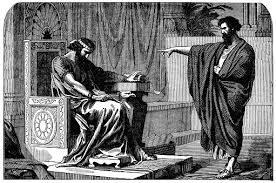
THE WORD JEREMIAD MEANS a doleful denunciation. There was nothing in need of denunciation that Jeremiah didn't denounce. He denounced the king and the clergy. He denounced the rich for exploiting the poor, and he denounced the poor for deserving no better.
Memorial of Saints Martha, Mary, and Lazarus
Today we celebrate the feast of Saint Martha, Mary, and Lazarus. Interestingly, this is only the second time we are celebrating memorial of all three! Pope Francis included them in the General Roman Calendar “considering the important evangelical witness they offered in welcoming the Lord Jesus into their home, in listening to him attentively, in believing that he is the resurrection and the life.”

Thursday of the Seventeenth Week in Ordinary Time
Wildman Jeremiah alerts Judah that they are on the brink of disaster unless they return to the promises they made with the God of Abraham, Isaac, and Jacob. The God of Sarah, Rebecca, and Rachel.
Wednesday of the Seventeenth Week in Ordinary Time
We’re all searching for something. The human spirit is prone, perhaps even programmed to search. We all search – we search for happiness, we search for purpose, we search to find meaning, some search for wealth, prestige, success. Epic Heroes have been part of literature throughout the millennia, capturing our hearts and imaginations with their undaunted searching. We love these stories because they reflect us. Ultimately, the soul’s sole search is for God. In today’s Gospel, Jesus likens the Kingdom of Heaven to searching for something priceless and sacrificing everything to obtain it. Today, let us pray that Jesus and his Kingdom might become the one thing, the one necessary thing that we seek and value above all else.
Memorial of Saints Joachim and Anne, Parents of the Blessed Virgin Mary
The good news is, today’s Gospel reading is a reflection on an earlier Gospel reading. That makes today’s reflection both a reflection on the Gospel, and a reflection on a reflection on the Gospel!
Feast of Saint James, Apostle
Remember that old saying, born of frustration: “If it’s not one thing, it’s another!”
A friend’s kids turned that into a way to tease her: “If it’s not one thing,” they quipped, “it’s your mother.”
Saturday of the Sixteenth Week in Ordinary Time
In today’s first reading from the book of Jeremiah, we are given a message from God delivered by Jeremiah to God’s people. The words are striking in their call to the Jewish people to make their worship congruent with their actions. In order to fully understand this message, we need to know a bit about the temple in Judaism.
Feast of Saint Mary Magdalene
Friends–Today we celebrate the feast of Saint Mary Magdalene and what a beautiful series of readings to reflect on as we wrap up the week. In one of our optional first readings, we are told that Christ impels us. Impels, urges, drives, directs us to what exactly? To no longer live for us. We are compelled to let go of our ego, turn away from sin and selfishness, and accept the love of Christ, live for the love of the other; “The old things have passed away; behold, new things have come” (2 Cor 5:17).
Thursday of the Sixteenth Week in Ordinary Time
Scripture Readings
I have wondered for a very long time why Jesus speaks in parables. After all, Jesus is God and knows all. Jesus is incarnate and lives among human beings as a human being. While he is on earth, he has this incredible opportunity to tell us humans who God is, what God wants, how to follow him, and so forth. Surely, he wants to make all that clear.
Tuesday of the Sixteenth Week in Ordinary Time
“God will cast our sins into the depths of the sea.” It’s beautiful, isn’t it? Yet today, many of us are often unaware of our sins. We may feel inadequate or be aware of our weakness, but we are quick to forget our sins. If we don’t know our sinfulness, it will continue to weigh us down in secret. Our Lord offers something better. The Spirit can cast light upon our sins, so that Jesus can free us from them. A good examination of conscience isn’t one that makes us feel small or pathetic; it is one that opens us to God’s uplifting, cleansing Love.
Wednesday of the Sixteenth Week in Ordinary Time
In the Gospel, Jesus offers a rich and vivid picture of the distribution of his Word. As Christ scatters this seed abroad today, let us examine our hearts and souls to discover the type of soil that comprise them. Let us also ask ourselves what we’re doing with God’s Word – how and where and with whom are we sharing it? Perhaps today might be a day in which the Holy Spirit cultivates us such that we can receive God’s Word with greater joy and become more fruitful disciples.

Sixteenth Monday in Ordinary Time
“What does YHWH require of you? Only this: To do justice, love tenderness, and walk humbly with your God” (NJB). These words from the prophet Micah (6:8) are among the most beautiful and efficacious in the whole of the Bible.
Saturday of the Fifteenth Week in Ordinary Time
In today’s gospel reading, we hear about justice. Jesus is proclaiming justice and bringing justice to victory. What is the justice that Jesus is bringing to our world, and how are we called to follow Him in living out this justice today?
Memorial of Saint Bonaventure, Bishop and Doctor of the Church
“A spiritual joy is the greatest sign of the divine grace dwelling in a soul.” (St. Bonaventure) I wonder if it’s possible to be genuinely joyful and judgmental at the same time. I don’t think it is! Because, at least in my understanding, judgment is born of fear. And true joy is born of mercy and grace. Have you noticed that it seems the most judgemental people are also the least joyful? (Myself included when I’m not at my best.)