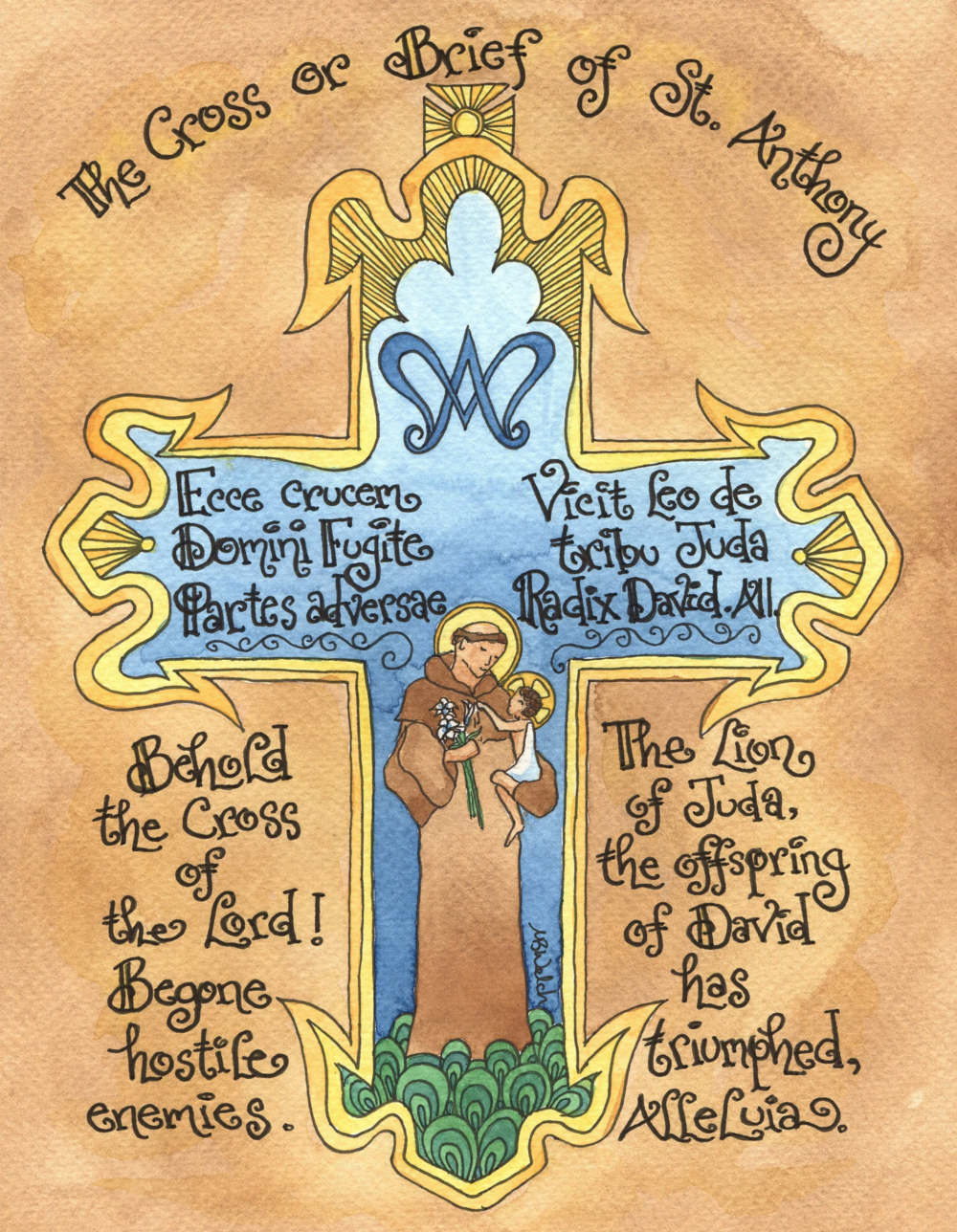
Memorial of Saint Anthony of Padua, Priest and Doctor of the Church
As a boy I would ride the bus with my grandmother on Saturday afternoons so she could go to confession at one of the various churches in the Mahoning Valley. She'd avoid our home parish since her thick Scottish brogue was a dead give away to the confessor, so we'd find our way to one of the “ethnic” parishes where her Gaelic lilt couldn't be so readily recognized---Italian, Polish, Slovak, Hungarian, Croatian, Lithuanian or German. I'm probably missing a couple.
What fascinated my ten-year-old self on those Saturday jaunts was the liturgical art at these churches, especially their life size plaster statues. My favorite place was Our Lady of Mt. Carmel, the Italian basilica. They featured the most exotic images---Sebastian filled with arrows, Lucy holding her eyes on a plate, and Lawrence being grilled alive. But no matter which ethnic group was represented everybody had a statue of St. Anthony of Padua. And on the week prior and after his feast (today) he'd sometimes be covered with dollar bills taped to his plaster Franciscan habit.
Mary & I made a point, when we lived in Cincinnati, to attend mass on June 13 at the National Shrine of St. Anthony of Padua on Colerain Avenue in Mount Airy. Every year, up until the pandemic, several large bus loads from Detroit, full of mostly women of Lebanese decent, would descend on the shrine. It was an amazing scene. God help you if you got in the way as these ladies gobbled up the famed “St. Anthony bread” after mass. They had promised this holy bread to family and friends waiting back home in Michigan. The women were Maronite Eastern Rite Catholics, but they clearly loved St. Anthony of Padua, a saint of the West.
When Anthony was preaching in Southern France and teaching Scripture to the brothers there, a young Friar decided to leave the order. On his way out, he stole a handwritten copy of the Psalms, the only one they had. This rare and difficult-to-replace manuscript included Anthony's teaching notes.
On learning of the youth's departure and theft, knowing the time plus the expense of replacing that copy of the Psalms, Anthony prayed that this former friar might have a change of heart. The young man returned the manuscript and resumed his life as a friar. Since then, people have been asking Anthony's help in finding lost objects.
Anthony has assisted millions to find lost articles for nearly seven centuries. He seems to know where we've misplaced keys, wallets, important papers, etc. But we'll have to wait until we meet him in heaven to ask the greatest riddle of the universe: what happens to all those socks that are lost in the dryer? Not even Anthony can find them---sort of his kryptonite.
Once aMaybe a lost article has been found, the tradition is to give alms to the poor in the good saint's name, a practice known for centuries as “Saint Anthony's bread.” Or simply write “Thank you Saint Anthony” on the edge of a dollar bill and give it to a homeless person. Maybe a five, given inflation.
Usually depicted as an emaciated youth (he died at 33), Anthony actually was rather robust. Let's just say his habit required a bit more brown material than those of his brothers. He enjoyed a hardy meal. Although known as a “hammer of heretics,” he's also been labeled, “gentlest of saints.”
Gentle, perhaps, but also an intense guy with a golden tongue. Centuries after Anthony of Padua died his body was exhumed to see what condition it was in. (We Catholics like to do this sort of thing, earthy people that we are.) His body was corrupted but his tongue was in its natural state, so perfect were the teachings formed upon it. His dream was to travel to Morocco to be promptly beheaded by the Moors. St. Francis thought otherwise. Anthony was a mixed bag like the rest of us.
If our saint was gentle, his inspiration could readily be “found” in the Sermon on the Mount (Matthew 5), partly heard in today's Gospel. “Offer no resistance to one who is evil,” “Turn the other cheek,” “Do not turn your back on the one who wants to borrow.”
The Sermon on the Mount is both Constitution and Bill of Rights for Christians. It is our prescription for discipleship. None of us can fully live it, not in this life, but all we baptized must make building the Kingdom our life's work.
Matthew's rich Judaic Gospel presents Jesus as our new Moses the lawgiver. Like the “Mount” from which the hand of God wrote the 10 Commandments (Sinai), our Greater Moses, Jesus Christ, gives the “new law,” likewise on a “Mount.” But unlike Moses, Jesus gives this greater law by his own authority.
Anthony of Padua lived and breathed the teachings Christ our new lawgiver gave on that new “Mount.” This, through the grace of God, is why we proclaim the saints because they, like us, are redeemed sinners. We proclaim the saints, too, because God has proclaimed them first.
Let us pray,
Good and gracious God, who gave Anthony of Padua to your people as an outstanding preacher and intercessor in their need, grant that, through his assistance as we follow the Gospel, we may know your help in every trial.
Blessed be God in his angels and in his saints!
Timothy J. Cronin