Monday of the Third Week of Advent
Today's reading from Numbers was an important source for Matthew when he crafted his version of the Christmas story (Luke would write a very different version years later).
At the risk of racing to the Epiphany (on January 5th of this liturgical year) and at the cost of keeping a good Advent, it is helpful to note that the author of Matthew relied on Numbers 22-24 when committing his reed stylist to papyrus in the story of the magi. Thus, he used images well known to his Jewish-Christian audience.
Memorial of St. John of the Cross, Priest and Doctor of the Church
Both of today’s readings mention Elijah. In the Book of Kings, Elijah tells the Israelites to turn back to God and stop worshipping the idols of Baal. The first reading refers to the conflict or showdown between Elijah and Baal’s prophets and the subsequent result of the Israelites conversion to God (1 Kings 18:1-45). Throughout the Hebrew Scriptures, the Israelites struggled with worshipping idols and other gods. For us today, this reading can help us reflect on who or what are the “idols” of our time? Is it wealth, status, career, our appearance, pride, etc? How do we struggle with them throughout our lives?
Memorial of St. Lucy, Virgin and Martyr
You’ve probably heard this saying (or something like it), “You can please some of the people all of the time, you can please all of the people some of the time, but you can’t please all of the people all of the time.” Well, today’s gospel reading from Matthew (11:16-19) reminds me of this.
Feast of Our Lady of Guadalupe
Today is the Feast of Our Lady of Guadalupe. Mary is our perfect role model, since her “yes” to God allowed her to bring Jesus into the world. Her faith in God’s ability to do wonderful things not just for herself but for all nations reveals the deep hope and joy that she possessed even in the midst of her many sorrows. Today’s feast reminds us that Mary always leads us to Jesus, and therefore to the hope and joy of knowing God’s love for us is everlasting.
Wednesday of the Second Week of Advent

One of the most popular films I showed to the boys at St X over my 3+ decades teaching there was Remember the Titans (2002). The storyline concerns a high school football team and community in northern Virginia during the height of the Civil Rights movement.
Tuesday of the Second Week of Advent
“Like a shepherd, he feeds his flock and gathers the lambs in his arm.” It’s hard not to hear this song refrain by Bob Dufford when listening to today’s first reading. The whole reading is one of those WONDERFUL advent readings we get in this first week but it’s the end lines about the shepherd that points us to the Gospel today.
Solemnity of the Immaculate Conception of the Blessed Virgin Mary

On our patronal feast day I offer this reflection on the prayer Hail, Holy Queen:
Hail, Holy Queen, Mother of Mercy! Mary is a woman of mercy because she was a woman of suffering. She knew the sorrows of being an unwed mother, refugee, widow and mother of a condemned and executed criminal. Jesus weeping over Jerusalem and weeping over Lazarus reveals a man of deep compassion. In Jesus we see the heart of his mother.
Memorial of St. Ambrose, Bishop and Doctor of the Church
This is hard to admit but here it is. The second most common lie I tell (the most common is the "I have read and understand the terms and conditions" box) is "I'll pray for you" or some variation of that sentence. I make the promise and then something hinders me. Maybe it is my own forgetfulness or my time for prayer gets rushed, etc. Why I fail to follow through is irrelevant. The reality is, my follow through in this regard does not match that of Jesus' in today's gospel.
Friday of the First Week of Advent
I love living with kids! Why? Their willingness to believe; to approach life with wonder, curiosity, trust, openness, joy, authenticity. Our kids are so excited to start preparing our home for the coming of Christmas. We attempt to be very intentional in emphasizing the season of advent, trying to tie together the excitement of receiving presents at the end of 4 weeks of waiting and the gift that is the Birth of Christ, Emmanuel, God with us. Santa Claus is a central figure this time of year and as much as I am tempted to push back on the commercialism of Christmas, there is a beautiful faithfulness in talking to our kids about Santa. Christmas today has become this crazy mashup of celebrating Jesus’ birth and the legend of St. Nicholas, the 4th-century Eastern European bishop. Is Santa real? Yes, and he lived several hundred years ago, was known for his incredible generosity and compassion for others, and slowly developed from Nicholas to Saint Nicholas to the Dutch version Sint Nikolaas to Sinter Klaas and finally, Santa Claus.
Thursday of the First Week of Advent
Today's gospel is one that many of us are familiar with - a house built on sand will crumble and fall, but a house built on a strong foundation of rock will be able to withstand the storms of this world.
Wednesday of the First Week of Advent
Isaiah is our constant companion this season. His name means “Yahweh is Salvation,” and he points us to Jesus, our own path to salvation. In today’s first reading he tells us of a mountain on which the Lord of hosts will provide for all people. He will provide a feast of rich foods, wipe the tears from every eye and destroy death forever.
Memorial of St. Francis Xavier, Priest
We journey into the Advent season Scriptures which give many words of hope and encouragement, and wonderful symbols to delight the child within each of us. Our readings today especially speak to our child-like spirits. Can we recall our own childhood and how our imaginations would let us into the world of pretend, where what was impossible in real life was so real and enjoyable. Children have little difficulty moving between the imaginary word of play and the physical world.
Monday of the First Week of Advent

Not long after the ghosts and goblins haunt our front porches, “chestnuts start roasting o’er an open fire” and “Jack Frost nipping at your nose.” Some have labeled this the “Christmas madness.” Yuletide begins earlier and earlier so we might ask the question, “Whatever happened to Advent?” After all, it is Advent that gives Christmas its meaning. The “Yule” makes no sense apart from the “yearn” (for Christ to come).
Feast of St. Andrew, Apostle
In today’s first reading, St. Paul wrote to the Romans, "There is no distinction between Jew and Greek; the same Lord is Lord of all,” (Romans 10:12). In the early Christian community, there were two main cultural groups: Jews and Greeks (or Gentiles). These two groups had different customs and traditions. Sometimes they clashed, such as whether or not all men should be circumcised and dietary laws (see Acts 15:1-21). Therefore, Paul told the Christians in Rome that the uniting factor of believing in Jesus Christ is primary. He echoed Jesus’ redefinition of family in which membership is given by God and not determined by genes, lineage, or marriage (see Matthew 12:49-50 and Luke 8:21). Indeed, this happens today every time we worship together or gather together because of our faith. When I attend Mass, there are many people of different ethnicities, races, and political beliefs, but we all come together in church to worship. No one is or should be turned away at the door. We can all be witnesses to God’s love for all people.
Friday of the Thirty-fourth Week in Ordinary Time
“Even the sparrow finds a home, and the swallow a nest in which she puts her young…” (Psalm 84:4a) Maybe this verse from today’s Responsorial Psalm particularly speaks to me now that my husband and I are considered “empty-nesters” welcoming some of our “not-so-young” back to the nest for Thanksgiving. But I think it’s more than that. Today’s Psalm is called the Prayer of a Pilgrim to Jerusalem, and biblical commentary (NAB) tells us it “expresses the sentiments of the pilgrims eager to enjoy the divine presence.” As the birds find their home, their nest, so “My home is by your altars, Lord of hosts, my king and my God!” (84:4b) And what about us?
Thursday of the Thirty-fourth Week in Ordinary Time—Thanksgiving
Today’s readings for Thanksgiving Day focus on praise and gratitude for all that God has done. Even Jesus reminds us of the importance of giving thanks in today’s gospel. Our many blessings bring us joy, and we are called to remember these gifts have been given to us, so that we can share them with others.
Wednesday of the Thirty-fourth Week in Ordinary Time
As the liturgical year comes to a close our readings continue the theme of the end times. It amazes me sometimes how many people think the literal end of the world is near. This morning I was talking with this Catholic family who described how now was the end times, because of the writings of some priest from 40 years ago. In contrast I stood with a patient as the doctor told them there was nothing more they do to improve the persons health. In one case the family was afraid of the predicted doom, in the other a patient offered courageous acceptance of the real outcome of their condition.
Tuesday of the Thirty-fourth Week in Ordinary Time
The context of today's gospel (Luke 21:5-11) is important. In verses 1-4, Jesus has just finished praising the widow who has given everything she has - two coins - to the treasury in the temple. She is compared to everyone else who gives out of their generosity, but she gives out of her poverty and Jesus clearly sees her as giving a better offering than the others, because she gives to God everything that she has.
Saturday of the Thirty-third Week in Ordinary Time
Today’s Gospel tells of an encounter between Jesus and the Sadducees. The Sadducees were an aristocratic class of priests who only accepted the first five books of Hebrew Scriptures called the Torah, refuted oral legal tradition, and denied teachings not found in the Torah including the resurrection of the dead. Therefore, in this exchange, the Sadducees try to trap and challenge Jesus on the teaching of the resurrection by bringing up a seemingly ridiculous example of seven men who married the same woman. Jesus dodges the trap by quoting from the Torah, “That the dead will rise even Moses made known in the passage about the bush, when he called ‘Lord’ the God of Abraham, the God of Isaac, and the God of Jacob; and he is not God of the dead, but of the living, for to him all are alive,” (Luke 20:37-38). Thus, today’s Gospel is really about eternal life.
Monday of the Thirty-fourth Week in Ordinary Time
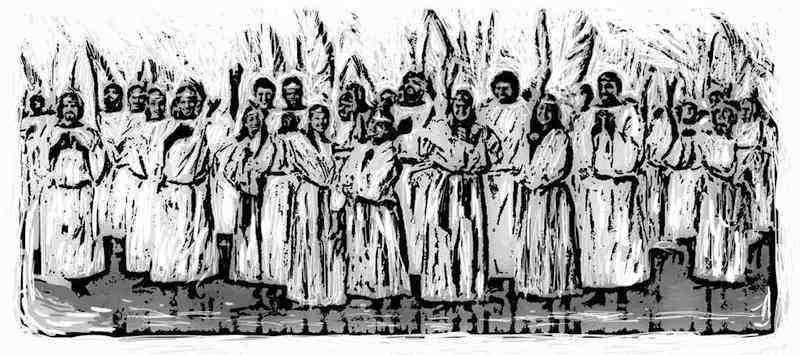
Why are only 144,000 redeemed and joyous around the throne of God as we hear in today’s rendition from Revelation? Are only 144,00 saved?
Numbers don’t always mean what they seem. Walking into Partial to Pie on Wayne Avenue we can order a baker’s dozen. How many donuts is that? In the early days of television if you answered the $64,000 question correctly would you have been able to retire? Why is “16” sweet? Why is “7” considered lucky in the roll of the dice?