Feast of the Exaltation of the Holy Cross
Today we celebrate the Feast of the Exaltation of the Holy Cross. This feast traces back to when St. Helena discovered the True Cross in Jerusalem during a pilgrimage in the Holy Land. The Basilica of the Holy Sepulcher was built on that site and the cross was soon venerated.
Memorial of Saint John Chrysostom, Bishop and Doctor
This week, I had the special privilege of visiting the Paul Laurence Dunbar House and learning more about the gifted and prolific poet and author from Dayton. It is a national historic site, and I strongly recommend visiting. During my visit, I was struck by this quote from one of his writings in the 1890s, “So you must but bear in mind that the agitation of deeds is tenfold more effectual than the agitation of words. For your own sake, and for the sake of Heaven and the race, stop saying, and go doing.”
Thursday of the Twenty-third Week in Ordinary Time
If anyone wonders what it means to follow Jesus, the text before us today from Luke makes it clear. And it is one tall order.
Wednesday of the Twenty-third Week in Ordinary Time
The readings today are challenging on many different levels. Paul’s letter to the Corinthians on first glance seems to be calling us to a life of celibacy. Indeed, in this section of Corinthians, Paul suggests, “let even those who have wives, be as though they had none.” These words were Paul’s opinion based on the reality of the situation as he understood it.
As it was Paul believed that the Christ’s return was imminent. This letter was some of the first New Testament writings, penned even a decade before the first gospel. Paul, along with many in the early church, believed that Christ would return within their own lifetimes. It is with that understanding that today’s reading is best reflected upon. For Paul, there was no need to marry. Paul suggests that the world, in its present form is passing away. Paul like a good parent is trying to protect his spiritual children.
Tuesday of the Twenty-third Week in Ordinary Time
Jesus departed to the mountain to pray, and he spent the night in prayer to God.
–Luke 6:12
Many Gospel stories tell of Jesus taking time away from the crowds and his devoted followers to be alone with God in prayer. The busier the days, the more he awoke early, or made sure to depart to a ‘lonely place’. In today’s Gospel, he heads to the mountain—whose heights give a fresh outlook and whose clefts give a place of shelter through the night.
Memorial of Saint Peter Claver, Priest
“You are inflated with pride.” - 1 Corinthians 1:2
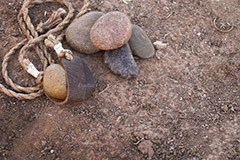
Today Paul comes down hard on the community of believers at Corinth because of their exaggerated pride, rightly labeled “hubris.” He assails the Corinthians for being "puffed up" or "arrogant."
Saturday of the Twenty-second Week in Ordinary Time
In the first reading, Paul writes that he and another preacher, Apollos, have become a spectacle. A spectacle refers to something unusual, notable, or entertaining. In a way, Paul suggests that we are to be Christian spectacles by emphasizing, “We are fools on Christ’s account.” He compares his condition to the Corinthians by describing himself as “weak” and “in disrepute” and the Corinthians as “strong” and “held in honor” in order to remind them to focus on Christ’s message and to be a witness to the Reign of God, a place where present conditions are reversed. He gives examples in his letter, “when ridiculed, we bless; when persecuted, we endure; when slandered, we respond gently.”
Friday of the Twenty-second Week in Ordinary Time
“Therefore, do not make any judgements before the appointed time, until the Lord comes, for he will bring to light what is hidden in darkness, and will manifest the motives of our hearts, and then everyone will receive praise from God.” This last verse from today’s reading from Paul’s first letter to the Corinthians (4:1-5), stood out to me – especially the last phrase, “then everyone will receive praise from God.” ! It makes me wonder, was Paul using some sarcasm there? Or being encouragingly optimistic about the motives of the people of Corinth’s hearts?
Thursday of the Twenty-second Week in Ordinary Time
Today’s scripture readings are reminders that God calls each of us to be with Him. Our choice lies in the ability to trust in God instead of relying upon our own wisdom and strength. It is in our humility to say “yes” that we are able to follow and become a disciple of Christ.
Wednesday of the Twenty-second Week in Ordinary Time
The early Church at Corinth suffered from division and disunity. St Paul’s first letter addresses all its many unhealthy expressions. In our passage today, we see Paul attempting to hold the Corinthian Christians accountable for forming cliques around certain leaders rather than following Christ as a unified Body. Paul addresses these believers with a specific analogy, and it applies to us today. It’s this metaphor that I want to zero in on today, and also to remind us that we, like Paul and Apollos, are God’s co-workers. Are we growing and equipping ourselves for this assignment?
Memorial of Saint Gregory the Great, Pope and Doctor of the Church
“The Spirit scrutinizes everything” (1 Cor 2:10B). Does that make you nervous? Or are you looking forward to a good look-over from the Spirit? Personally, I don’t enjoy it when someone is looking carefully through my personal business, because I think it’s none of theirs. But we all belong to the Lord, and we were made to serve God by working for the Kingdom. Jesus has redeemed our lives from sin and death, and so our lives and everything that pertains to us is God’s “business.”
Monday of the Twenty-second Week in Ordinary Time
Following his baptism at the Jordan and his showdown with the devil in the wilderness, Jesus returns home to Nazareth’s familiar synagogue. Neighbors gathered on that Sabbath would have known him since infancy. But this time his homecoming caused an uproar.
Saturday of the Twenty-first Week in Ordinary Time
Today’s readings seem a bit harsh. In the first reading, Paul in a way calls the recipients of his letter foolish, weak, and despised. In the Gospel, the “Master” or owner takes away the talent of one of his servants. However, neither reading is meant to be harsh. They can give us insight as to how to live as a disciple of Jesus.
Friday of the Twenty-first Week in Ordinary Time
“How good is the good God!” As I spent time with the psalm for today, this familiar quote from St. Julie Billiart keeps reverberating in my thoughts. It is a quote of awe and wonder at the beauty that exists in creation. I am well-aware that goodness is sometimes clouded heavily by bad news seemingly around every corner–most media outlets suffer from “bad news bias” and operate under the motto “if it bleeds, it leads”. However, today I am drawn to our psalm refrain: “The Earth is full of the goodness of the Lord.” (Ps 33:5) There is beauty to be found in creation, in our relationships, in our work, in our play, in our joy, and even in our struggles.
Memorial of the Passion of Saint John the Baptist
Let’s just be honest. The Bible is, in many ways, a foreign country. There are lots of stories that feel right—like when Mary responded to Gabriel with a resounding yes or Jesus healed the woman who had been bleeding for years or the Samaritan crossed the road to help an untouchable in need. And then there are other stories—the foreign ones. Like the one from the Gospel of Mark that is before us today.
Memorial of Saint Augustine, Bishop and Doctor of the Church
I currently teach 6 – 9-year-olds in a Montessori classroom. My co-teacher and I spend a lot of time talking about the “prepared environment.” A lot of time, energy, planning and preparation goes into setting up the room so that students can use the space appropriately to learn and grow. We often talk about how the adults in the room are part of the prepared environment. To prepare ourselves means taking time for quiet, for self-reflection, for training. If the adults have not consciously taken time to prepare their hearts and minds for this work it will seem empty and meaningless – and believe me, kids can pick up on that.
Memorial of Saint Monica
May the intercession of St. Monica, our Lord Jesus Christ himself and God who has loved us and given us everlasting encouragement and good hope through grace, encourage your hearts and strengthen them in every good deed and word.
Today we celebrate the Memorial of St. Monica, a fourth century saint and mother of St. Augustine of Hippo (memorial on August 28th), who became a Bishop and Doctor of the Church. Monica was in an abusive marriage and her long-suffering patience, sorrowful tears and persistent prayers for changes in her husband’s violent temper and her son Augustine’s immorality are attributed to both of their conversions to Christianity and leading virtuous lives. Her faithfulness in prayer and belief that things can change are a model for us all. She is a patron saint of wives, mothers, conversions, alcoholic and abuse victims.
Monday of the Twenty-first Week in Ordinary Time
Years back a friend of ours from our former parish in Cincinnati lost her forty year old husband suddenly to a heart attack,
leaving her to raise their four boys alone. She was a convert to Catholicism, raised in a strict fundamentalist faith. Her father was a preacher in that faith.
The funeral liturgy was both beautiful and heart breaking. There was just one oddity. And it was a whopper. Her father preached the sermon (not really a homily) and it was all fire and brimstone. He used the opportunity to warn those of us who didn’t accept-Jesus-Christ-as-our-personal-Lord-and-Savior (according to his formula) that we would be dragged down into the pit by Satan himself. And the word he emphasized continuously was the word “Woe.”
Feast of St. Bartholomew, Apostle
Today is the feast of St. Bartholomew, and today’s Gospel tells the story of how Nathanael, also known as Bartholomew, met Jesus. Jesus observed that “there is no duplicity” in Bartholomew. This reading encourages us to look at ourselves and see if there is any duplicity in our lives.
Friday of the Twentieth Week in Ordinary Time
A sound started up, rattling like thunder. The bones came together, bone joining to bone. Sinews appeared on them, flesh grew over them, skin covered them on top (Ez 37:7-8). Our boys are big fans of Super Mario Bros (as is dad). I couldn’t help but think of one of the characters as I spent time with Ezekiel. In Super Mario, Dry Bones are skeletal versions of Koopa Troopas–villainous turtle members of an evil army led by their angry and antagonizing dragon-like leader, Bowser. Their purpose is to stop Mario and Luigi from saving Princess Peach. Not quite a direct parallel to our reading but Dry Bones is part of a massive army of Koopas. Similarly, we read that Ezekiel connected dry bones that soon “stood on their feet, a vast army.” (Ez 37:10) What an amazing scene from the exile when he is told to call forth new life from a field strewn with dry bones.