Memorial of Our Lady of the Rosary
“I am amazed that you have so quickly forsaken the one who called you by the grace of Christ for a different Gospel.” —Galatians 1:6
So Paul writes to his foundling community in Galatia. Truths divergent from the ones Paul preached reared their ugly heads among neophyte believers there. This confused and unsettled those new converts. Paul’s concern in the early 50s can be applicable to many false gospels making the scene over two millennia since. One such is today’s abhorrent “prosperity gospel.” Another, and a far more common one, is a more divergent gospel than the prosperity travesty, as we will see.
Saturday of the Twenty-sixth Week in Ordinary Time
“But now my eyes have seen you.” —Job 42:5b
“Blessed are the eyes that see what you see.” —Luke 10:23b
I find it interesting that today’s readings refer to seeing. Job sees and understands the movement of God in the world and that he doesn’t have as much control as he thought. The disciples see the mysteries of the kingdom of God because of their faith in Jesus.
Memorial of Saint Francis of Assisi
Between today’s First reading from the Book of Job and our Psalm response, we get a pretty strong sense of God’s power and wonder especially in contrast to our own humble origins and limitations. Job is left practically speechless when God pretty much puts Job in his place, addressing Job out of the storm: “Have you ever in your lifetime commanded the morning and shown the dawn its place…Have you ever entered into the sources of the sea…Have the gates of death been shown to you, or have you seen the gates of darkness?” The author of this Old Testament book even has God using a little sarcasm in addressing Job, “You know, because you were born before them, and the number of your years is great!”
Thursday of the Twenty-sixth Week in Ordinary Time
While reading today’s readings, the word “other” caught my attention. Jesus appoints “other” disciples to help prepare the way for him. The definition for the word “other” includes “a person or thing that is different or distinct from one already known about.” It can also mean “that which is distinct from, different from or opposite to oneself.” This concept of “other” has been something I have heard about in recent conversations, articles and podcasts. Who are those we call “other” and how are we called to care for them and their needs?
Memorial of the Holy Guardian Angels
“The disciples approached Jesus and said,
‘Who is the greatest in the Kingdom of heaven?’
He called a child over, placed it in their midst, and said,
‘Amen, I say to you, unless you turn and become like children,
you will not enter the Kingdom of heaven.
Whoever humbles himself like this child
is the greatest in the Kingdom of heaven.
And whoever receives one child such as this in my name receives me.’”
The disciples approached Jesus with their query much like we would tend to do – through a worldly, self-centered, self-conscious lens. They, like we, assess greatness by the measuring rod of success, accomplishment, achievement, competition, power, authority. We compare ourselves to others and then seek to triumph over them. We strive and grasp for all the things we assume will make us great – great in our own eyes and great in the esteem of others.
Memorial of St. Therese of the Child Jesus, virgin and doctor of the Church
Today the first reading is taken from the final lines of the book of Job. Now, I have quite the personal connection with Job - that is, our names are very close in spelling. But on a deeper note, we all have a connection to our main character in a way.
You may or may not be familiar with the entire story of Job and his lamentations. If not, I recommend stopping now, read it, and come back to my reflection after. … Back already? Oh, you don't have time to read it? That’s okay, I didn’t reread while typing out my reflection. So let’s say that we did!
Memorial of St. Jerome, Priest and Doctor of the Church
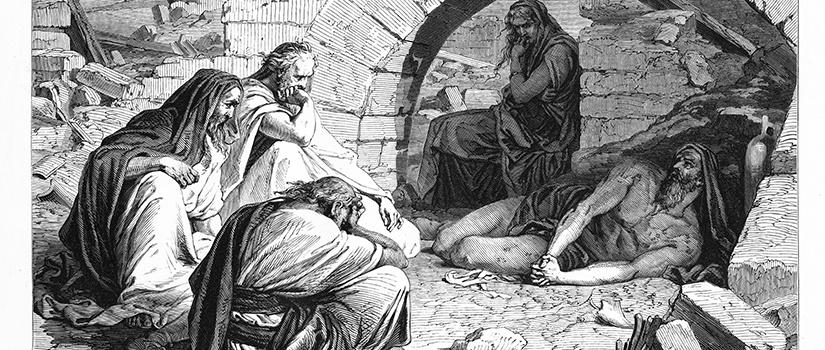
Poor Job. His life a shambles, he had every reason to wail against his Creator. But Job isn’t the only figure in a tet-a-tet with God in this oft-told tale. Satan is a character in the drama, too. In ancient traditions and in the long ago religions of the Tigris-Euphrates Valley, Satan’s original purpose was to serve as “prosecution attorney/accuser” regarding whether someone should or should not have the favor of the Almighty.
Saturday of the Twenty-Fifth Week in Ordinary Time
Both of today’s readings are difficult and discouraging to read. The first reading from Ecclesiastes talks about the sun darkening, the pitcher shattering, the pulley breaking and falling, etc. It’s almost apocalyptic. In the Gospel, Jesus tells his disciples that he will be arrested (which will lead to his crucifixion and death), but they do not understand. What does this all mean? Like the disciples, do we understand what is being said?
Memorial of Saint Vincent de Paul, Priest
Today we celebrate the Memorial of St. Vincent de Paul, the French priest who dedicated much of his life to serving the poor. This feast has a special place in our hearts because he is also the namesake saint of our oldest son. In our gospel, Jesus asks his disciples, “Who do you say that I am?” (Lk 9:20) It is a striking question for us to consider. Might we attribute the voice of that question today to Jesus, St. Vincent de Paul, and even to ourselves?
Thursday of the Twenty-fifth Week in Ordinary Time
Poor Herod. He had John the Baptist beheaded at his daughter’s request (see my previous reflection on August 29 for more on that). Behind the scenes was Herodias, Herod’s wife, who found John the Baptist very threatening. She wanted him dead. Herod found him unsettling, though he was also aware that he kept wanting to hear what John the Baptist had to say.
Wednesday of the Twenty-fifth Week in Ordinary Time
Part of my weekly Saturday routine is to make a meal plan for the meals we will prepare in the coming week. Then I use this to make the grocery list. I compile a list of all the food we will need to feed my family of 6 for the week. It is usually a long and expensive list of food. I often find this planning process to be a tiresome chore, but I know that being able to not only plan in this way but to purchase food before it is needed makes me rich indeed.
Tuesday of the Twenty-fifth Week in Ordinary Time
Today’s Scriptures invite us into the process of discernment. It is a difficult challenge to truly listen deeply, and to hear what is meant by the other—through the Word of God in Scripture, or the voices of my brothers and sisters—be they my neighbor, co-worker, part of my Family of Parishes, or relatives in my extended family.
Memorial of Saint Pius of Pietrelcina, Priest

“No one lights a lamp to conceal it or place it under a bed. Rather they place it on a lampstand so that all may see the light.” —Luke 8:16.
“When others see us, may they not see us but the Christ light shining through us.” —CS Lewis.
Our light, who is Christ, was meant to shine through those inflamed with his light. Have you met such persons along the way, those who “shine like the sun”? Christ-light people (“Christ-lighters”) have an inner serenity which adversity cannot ruffle. They have a strength that illness cannot weaken. They have a confidence that not even dying can wipe away. Their inner light shines from deep within – the light of Christ.
Feast of Saint Matthew, Apostle and evangelist
In today’s Gospel, Jesus calls Matthew to follow him. Remarkably, it seems that Matthew gets up and follows Jesus without hesitation. The passage doesn’t imply that anything else happened to Matthew before the encounter or during the interaction with Jesus. This story can help us reflect on our call from God. When God calls do we follow? How have we followed God’s call for us?
Memorial of Saints Andrew Kim Tae-gon, Priest, and Paul Chong Ha-sang, and Companions, Martyrs
Today’s short gospel passage from Luke (8:1-3), just three verses, may not seem noteworthy at first glance, but it is rich in what it conveys about the important role of women in Jesus’ ministry. “Accompanying him were the Twelve and some women…who provided for them out of their resources.”
Thursday of the Twenty-fourth Week in Ordinary Time
Throughout the gospels (including today’s reading), Jesus says, “Your faith has saved you.” What might Jesus be saying to us about the importance of faith and mercy in our lives?
Wednesday of the Twenty-fourth Week in Ordinary Time
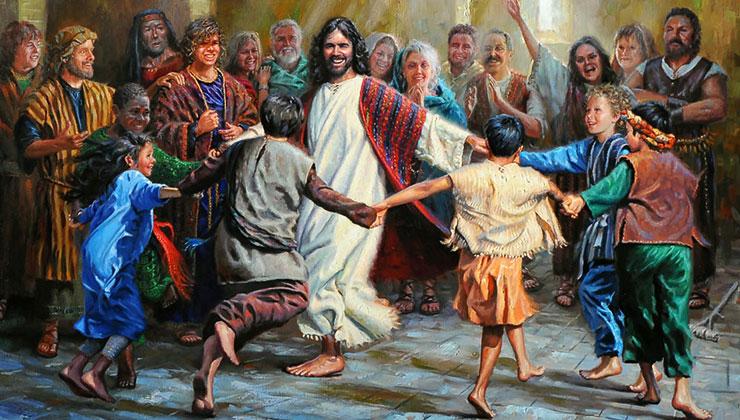
Where have spontaneous children’s games gone in our era of “play dates”? Myself a baby-boomer, in the ‘50s & ‘60s neighborhood children would race home after the final bell, change their school clothes, finish up homework (or at least say we did) and then run out to join the myriad of kids outside (large families were common in baby-boomer days). Playing hard, we would leave the fun once the “street lights came on.”
Tuesday of the Twenty-fourth Week in Ordinary Time
Reflecting on today’s readings, I can’t help but hum the hymn to myself: “We are many parts, we are all one body. And the gifts we have, we are given to share…” Singing together is such a powerful way to establish group identity. When many voices join in one song, our unity as God’s people, the Body of Christ, is made clear. We make it a point in our family to sing hymns together. It’s a simple, easy way to make the ‘Church at home’ a real part of our daily experience. We’re not great singers. But we like to sing, and it becomes a beautiful prayer to God, even when my voice or my children’s voice sounds a little hard on the ears! It doesn’t have to be perfect to have a positive effect on our life of Faith.
Memorial of Saints Cornelius, Pope, and Cyprian, Bishop, Martyrs
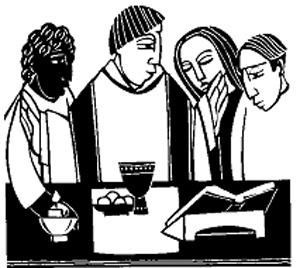
We hear familiar words in both readings today, familiar because they are spoken during the most important action of the People of God — the Mass. We hear or recite those words every time we gather to break-the-bread and to drink-the-cup.
Feast of the Exaltation of the Holy Cross
Today we celebrate the Feast of the Exaltation of the Holy Cross. This feast traces back to when St. Helena discovered the True Cross in Jerusalem during a pilgrimage in the Holy Land. The Basilica of the Holy Sepulcher was built on that site and the cross was soon venerated.