Friday of the Second Week of Lent
Jealousy can destroy. Jealousy within families is old, at least as old as the book of Genesis. We know the familiar story of Cain and Abel and how jealousy led Cain to kill his own brother. Maybe you know a personal story of jealousy destroying family bonds and connection. Today we read another familiar Old Testament story of sibling jealousy, the story of Joseph and his brothers. I invite you to reflect with me on this timeless story.
Thursday of the Second Week of Lent
For those of us who are blessed with the gift of sight, every second while awake we are surrounded by the colors, shapes, movements, textures, and details of the world around us. Although we can look around, how often do we really “see” what is right in front of us? So much of what is right in front of us is lost to our gaze because of inattention or distraction. Today’s gospel story reminds us to pay attention to what we see, and respond to these sights with faith filled actions.
Solemnity of St. Joseph, Spouse of the Blessed Virgin Mary
Today is the Solemnity of St Joseph, Spouse of the Blessed Virgin Mary. This celebration is a big deal! Notice that the Church includes a reading from the Epistles today, just as we receive on Sundays. This Solemnity should get our attention and capture our imagination in prayer as we reflect with gratitude upon the life and witness of St Joseph and his role as our Blessed Mother’s spouse and our Lord Jesus’ adoptive, legal father. As we meditate on the life of St Joseph, let us consider how we might emulate him in our love for God, our families, and every neighbor.
Tuesday of the Second Week of Lent
Prince of Gomorra! What a name! Why is Isaiah calling his readers this? There must be some bad people that the sacred author is addressing, right? But rather than punishment or vengeance, God is calling for repentance. ‘Set things right. Make justice your aim.’
If you’re reading this, you probably don’t consider yourself a prince or princess of Sodom. So is there anything in today’s reading for us, or is this just something we can throw at sinners even worse than you and I?
Monday of the Second Week in Lent
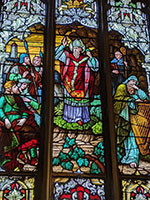
“We, your people and the sheep of your pasture, will give thanks for you forever; through all generations we will declare your praise.” - Psalm 79:13
The above verse from today’s Psalm is appropriate for the feast day of Ireland’s apostle. Although bonds of affection have strained in recent years, few countries have been as loyal to the Chair of Peter. (Winston Churchill once said, “The problem with the Irish is that they refuse to be English!”)
Saturday of the First Week of Lent
Today’s Gospel reading presents us with a challenging message: “Love your enemies, and pray for those who persecute you” (Matthew 5:45). We are encouraged to examine our relationships or non-relationships with others and to question our interactions with them.
Friday of the First Week of Lent
Recently, I saw a car parked in such a way that it covered one-and-a-quarter spaces. Its passenger-side tires sat several feet to the right of the yellow line. I know you’ve seen this before, too. The parking lot was packed, and the vehicle's irregular position eliminated an extra space.
What an inconvenience (unless you arrive on a motorcycle)!
I wish I had thought nothing of it and continued peacefully with my day.
But, alas, my heart shouted, “Raqa!”
“Fool!”
My interior name-calling did not affect the other driver one bit. It didn’t make my day any better, either.
Thursday of the First Week of Lent

We hear from the Book of Esther today. During the liturgical year the Church reads from Esther only twice. And always around the Feast of Purim (which takes place tomorrow).
The Book of Esther is unique as biblical works go. First of all a woman is the hero of the tale. A stunning beauty, to the king of the Persians she appears to be timid and simple, just the ticket — a gorgeous wife who won’t give his majesty any trouble, who will remain quiet and demure. Little did he know!
Wednesday of the First Week of Lent
After returning home from a mission trip (where I volunteered to work with children who had been removed from their homes as a result of the situations there), I was seriously angry at God. Realizing the anger was something that I needed to deal with I sought the Sacrament of Reconciliation.
“Jonah, isn’t he the whale guy?” This was the question that I asked the priest who had just assigned me reading Jonah as part of a penance. As a teenager who was unfamiliar with the story beyond the children’s illustrated version of the Bible,I failed to see any connection whatsoever between my confession and this penance.
Tuesday of the First Week of Lent
The word "Lent" comes from the Old English word læncte, which means "lengthening" or "springtime". Spring (in our eco-region) is a time of rains, longer days, change and growth expressed in today’s first reading. I grew up in Winnipeg, Canada, where foot-high snow often covered the ground throughout Lenten March. The snowmelt took weeks through April/May and as children we longed for the snow piles to melt so we could shift from hockey on ice rinks to street ball hockey and the snow-clear baseball season. We jumped on the ice-covered puddles to break them up and help the process along. Streets became mini-streams as the waters drained from roadways into our rivers and lakes. We couldn’t shift from snow boots to shoes until the ground was drier and the streets cleaned of the winter gravel and salting. The process took time. Melting snows are an important source of water for the deep soils of the North American prairies, which produce wheat and other grains as a ‘breadbasket’ for the world.
Monday of the First Week of Lent

Leviticus. Whenever I taught the Hebrew scriptures over the years my commentary on Leviticus: a sure cure for insomnia.
But that is hardly fair, in retrospect. Today’s 1st reading comes from the section of the book called the “Holiness Code.” Here, through his prophet Moses, YHWH is prepping the Chosen People for entrance into Canaan from where they were to become a blessing to the nations. And it is rooted in the call to be holy as YHWH is holy. Here the Priestly writers/editors of the Pentateuch (the first five books) repeat most of the Ten Commandments, defining what it means to be holy under the Holy One of Israel.
Saturday After Ash Wednesday
We are at the beginning of Lent. Today’s readings give insight into how we are to be throughout this season.
Friday After Ash Wednesday
I’ll be honest. I don’t really like fasting. I can easily be tempted to avoid it or find excuses for not fasting, but I do like what comes from it, the fruit of the discipline of it. And, of course, without the discipline we miss out on its fruit. I know I’m not alone in not particularly liking fasting. Afterall, it wouldn’t require discipline if it was easy or enjoyable. Yet, in some ways fasting is easier than what the Prophet Isaiah calls us to in today’s First Reading (58:1-9a).
Thursday After Ash Wednesday
As disciples of Jesus we are called to imitate Him in our daily lives. Today, Jesus tells us that we must deny ourselves and “take up our daily crosses.” What might that mean for us as Catholic Christians?
In today’s Gospel reading, Jesus tells His disciples about His passion, death and resurrection. He further explains that His disciples must also “take up the cross daily” to follow Him. It is when we “lose our life” for Jesus, that we are saved. As I reflect on this reading, I wonder what the disciples were thinking about these challenging commands.
Ash Wednesday
“Even now, says the LORD, return to me with your whole heart, with fasting, and weeping, and mourning; Rend your hearts, not your garments, and return to the LORD, your God. For gracious and merciful is he. . .” Thus begins our first reading from the prophet Joel. In our Gospel, Jesus calls us to pray, fast, and give alms as oblations of charity, as sacrifices of praise. The Church offers us this graced season of Lent as an opportunity to repent, to return to the Lord, to experience conversion. Let us consider today how we will enter into God’s invitation to become more like Christ.
Tuesday of the Eighth Week in Ordinary Time
My father died on Mardi Gras. Actually 25 years ago this year. But one of the most vivid memories I have of that time is the advice given to me the day before by an elder Marianist Brother that I was close to. We had been in communication about my worry about my Dad’s health and he said to me: “Wrap him in the Lenten Mystery.” My father went to heaven the next day, and I had no doubt about what I was “doing for Lent” that year.
Monday of the Eighth Week in Ordinary Time
At sundown tomorrow the great Paschal season of Lent-Easter begins. Some of us who knew the pre-Vatican II Church experienced Lent very differently than today. We grew up in a church caught between the eras of the Council of Trent and the Second Vatican Council. What follows are some recollections on my part just prior to my twelfth birthday when everything seemingly changed (although the essentials remained the same).
Saturday of the Seventh Week in Ordinary Time
In today’s Gospel, Jesus’ disciples rebuked the children for coming to Jesus. Consequently, Jesus gets angry at his disciples and tells them that they must be like children in order to enter the Kingdom of God. To our modern understanding, this might not make much sense. What message does this Gospel have for us today?
Friday of the Seventh Week in Ordinary Time
There is a well-known quote that states, “We are the average of the five people we spend the most time with.” I usually laugh when I read it because I wonder what that says about me considering that at least 4 of those people in my life are under the age of 10, so if I take the average ages of my children and my wife (even though that’s technically six people), I’m about the equivalent of an 11-year-old. I’m sure there is plenty of debate and disagreement about the accuracy of the above statement, but I do believe there is some truth to the idea that we are shaped by the people we surround ourselves with. Our first reading today from Sirach offers a compelling framework for the value of good friendship.
Thursday of the Seventh Week in Ordinary Time

“Salt is good, but if salt becomes insipid, what will restore its flavor? Keep salt with you and you will have peace with one another.” - Mark 9:50