Monday in the Octave of Easter
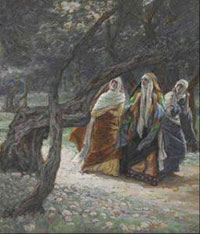
I’m passionate about the original ending of Mark’s Gospel, the conclusion that he had intended. It’s very early on Easter Sunday morning, while it is still dark. The myrrh bearing women come to the tomb to anoint the body of Jesus.
Underneath the Church of the Holy Sepulcher in Jerusalem, built on the outcrop of rock in a quarry that was called Golgotha, there are several first century tombs. They are little more than holes in the quarry walls. Jesus’ tomb would have been like that.
The women find the stone rolled away and inside the tomb, unique to Mark, is a “young man” (not an angel) seated at the right hand side. He announces the first ever Easter proclamation adding, “Go and tell Peter and the disciples that he goes ahead of you into Galilee. There you will see him.”
Now here’s the kicker: “The women fled from the tomb and said nothing to anyone because they were terrified.” The original ending of Mark was simply too awkward and unsettling for following generations to handle. So much so that two longer endings were added sometime in the second century.
Easter is, like Ohio, “the heart of it all.” The Gospels, starting with Mark, were composed “backwards,” beginning with Easter. Every chapter, every verse, every word of the New Testament permeates with Easter. Without Easter, what we know of Jesus of Nazareth would be limited to brief references by ancient historians Josephus and Tacitus.
Mark’s symbolic animal has been a lion. I suspect that our Evangelist, who invented the narrative Gospel literary form (he was the first), has been roaring with indignation about the tampering of his masterpiece and the misunderstanding of later editors of what his intent was.
There are echoes of Mark’s original ending in what we hear from Matthew today, written nearly 20 years later. Both Matthew & Luke add to and subtract from Mark and both correct Mark where they deem it necessary. Today Matthew adds an earthquake, guards at the tomb, a descending angel rolling away the stone, and the women themselves experiencing the Risen Christ. Then they all ran to tell Peter and the disciples.
We can surmise from this that the most ancient tradition is that Easter happened for Peter and the others in Galilee. That’s where they all fled after the arrest of Jesus and his crucifixion (Luke & John would change this later for literary purposes, where they stay in Jerusalem).
But the women fleeing from the tomb saying “nothing to anyone” is more identifiable to me about my own faith journey. It’s more unsettling, uncertain and there’s more mystery to it. There’s more of a demand for faith in it. Mark’s final word was “terrified.” Has there been terror in your life? Sorrow, confusion, helplessness, listlessness, loss, and fear are part and parcel for all of us. Is this not what the myrrh bearers knew, encapsulated in that one moment before sunrise at that hole-in-the-wall tomb, a stone's throw away from the giblet of torture on which their beloved rabbi died his excruciating death?
It’s back to Galilee that we see him. Where it all began it begins again. In Galilee of the first century and in all of our Galilees since. Where the messiah is least expected, there he is to be found.
—Timothy J. Cronin