Third Sunday of Lent
Human nature - there is much to be said about human nature. We have heard the saying, “To err is human; to forgive is divine.” At its core, this saying is about nature – human nature and divine nature. Or think about the times you wanted to do one thing but ultimately did something totally opposite. And you wonder, why! Here is an example from my life. During Lent, the day I decide to fast, that is the day I feel more hungry than other days. I blame it on human nature.
Second Sunday of Lent
There are things we know, there are things we don’t know, and then there is the unknown. The things we know help us to manage life. The things we do not know, we try to learn and master. But the unknown is what unnerves us. The unknown when someone loses their job; the unknown when divorce hits a family; the unknown when someone loses their spouse; the unknown when someone awaits a transplant; the unknown when someone is deployed; the unknown when someone we know battles addiction;, the unknown when someone is diagnosed with terminal illness; the unknown when someone goes missing – these unknowns take a heavy toll.
First Sunday of Lent
Yesterday, I celebrated the funeral of the woman who gave me my favorite Lent story. She was a very pious woman and had a great sense of humor. I visited her a couple of years back on Ash Wednesday because she had requested ashes. After the prayers, she asked me what I was giving up for Lent. Honestly, I don’t remember what my response was. And then she winked and said, “I am giving YOU up for Lent.” It was one of those rare times when I did not have a comeback.
Sixth Sunday in Ordinary Time
Within the span of one month, twice I have had to self-quarantine for seven days each. And then, to break the quarantine, I have had to get myself tested for COVID-19. Until the test results came, I have had to avoid physical contact with others. If I violate the laws governing my quarantine, I run the risk of endangering another person’s life. Moreover, whether at home in India or here in Dayton, I have had to announce my presence to avoid contact with others. After fourteen days of quarantine, let me say this out loud, “I hate it!” Now, can you imagine being quarantined for the rest of life? Perhaps, the pandemic and its implications for family, social, and religious life gives us a tiny window into the life of a leper in Jesus’ time. The only difference is that for a leper in Jesus’ time, being certified a leper was a death sentence. Even worse, leprosy was considered a punishment for sin. In this sense leprosy imposed and social, economic, and religious isolation that was literally a death sentence. No wonder, then, that were often called the ‘living dead.’
Fifth Sunday in Ordinary Time
If there ever is a time when I want to reflect on the book of Job, this isn’t that week. Job's experiences make him reflect on life and say, “Is not man's life on earth a drudgery?” (Job 7:1). Drudgery is one of my favorite words in the English language, but it is also a distressing word. Drudgery is an immensely burdensome state of being. I have just returned from home leaving my eighty-four-year mother behind. I wish I could put into words the sadness, the grief, heartache my mother and I feel. As I left home this time, I did not feel that I was merely leaving home. I felt that I was abandoning her. Yes, my life still has meaning, my ministry is still my life, and I am surrounded by very some supportive people, but at the moment, life feels like drudgery. My mother feels the same. My mother and I have our share of drudgery and you have yours. And certainly, the pandemic makes all this even harder. Perhaps I would not be wrong if I said that at the moment we are in global drudgery. Drudgery is real.
Third Sunday in Ordinary Time
Sunday of the Word of God
In normal circumstances, to compose a homily based on the call of Jonah or the call of Andrew, Simon, James and John would not be a very difficult task. But we are not living in normal times, are we? We are living in very tumultuous time. We are only days into a new administration in the nation, and the days that led up to it have been marked by uncertainty, violence, and death. I can only hope that immaterial of people’s diverse political loyalties, healing does begin after the inauguration. The focus of my homily is not politics, however. My focus is on discernment, more specifically, genuinely discerning God’s call. For instance, especially amidst the political turmoil in our nation, many Christians considered their political activism to be a divinely ordained. Many of them even resorted to violence believing that they were carrying out a divine mandate. Many Christians claimed that they were answering a divine call. Were they right? Were they wrong?
Fourth Sunday in Ordinary Time
At one of the Masses for our school students, the reading was about the kingdom of heaven. I began my homily by asking the students where they thought heaven was. There was a 7th grader in the very first row who was desperate to answer my question. “Go!” I said to him. Enthusiastically he stood up, pointed towards the sky and said, “There!” Isn’t it true that even as adults we point upwards when we talk about heaven? Don’t we always look up when we refer to God? And don’t we always point downward when we talk about hell. Yet the Catechism of the Catholic Church teaches us that heaven “does not mean a place ("space"), but a way of being” (2794). Why blame a 7th grader? I think we adults too hold very primitive views on our concept of heaven, hell and the kingdom of God.
The Baptism of the Lord
This has been a tumultuous week in America. January 6, 2021 will remain etched in the annals of American as a day of shame and revulsion. Americans, and indeed the world, witnessed scenes of lawlessness and anarchy unprecedented in the history of the nation. Motivated by the conviction to overturn, what they considered a fraudulent election, thousands of rioters overpowered law enforcement officials, unseated the legitimately elected representatives on Capitol Hill, and vandalized the very seat of American democracy! Thus far, five people have been killed, including a police officer who was merely carrying out his civic duty. The entire nation has yet to come to terms with the pivotal moment of American political history.
The Epiphany of the Lord
I am not sure if your Christmas tree is still up? Have you taken down the Christmas decorations yet? When I was a child back in India, the manger scene, the Christmas star, and all Christmas decorations were put away after Epiphany. I did not like this feast then. For me, it meant that Christmas was finally over. Life must get back to normal now. Liturgically too, Epiphany signals that the Christmas season is about to end. I understand the feast differently now. I look at Epiphany as a way to carry Christmas into the rest of the year.
The Holy Family of Jesus, Mary and Joseph
Each year at Christmas I have a difficult time balancing the hard realities that must have surrounded the Jesus birth and how they have been romanticized over the centuries. The annunciation, the visitation, Joseph’s dilemma, Quirinius’s census, Mary and Joseph’s travel to Jerusalem close to childbirth, the birth of Jesus in a stable, Jesus laid in a manger, Herod’ search for the child, the family’s escape to Egypt – it is possible to romanticize these events and lose sight of the realism of these events. The same can happen with the Feast of the Holy Family. It is true that two of the three people in the Holy Family were sinless, yet we can be sure that the Holy Family faced many of the complexities we do today. I am sure that they struggled like we do and found comfort in each other just as we do.
The Nativity of the Lord (Christmas)
Christmas 2020 is incredibly special. In fact, I believe that this is the most meaningful Christmas in recent times. I am not being cynical. For, if Christmas is the story of God gently touching a tragic and broken world, at no other time in recent history have we needed to experience divine touch more deeply than we do now. If Christmas is the story of God embracing the world with God’s redeeming love, then, “dear God, we need you right now!” There have been tragedies before, but a tragedy that has affected the entire globe simultaneously is new for us. Globally, COVID-19 has infected 78 million people and claimed 1.73 million lives. In our nation it has infected 18.5 million people and claimed 326 thousand lives. Perhaps, some of you present in this church or participating via live-stream have been tragically affected by the pandemic. It seems awkward, then, that I should wish you a Merry Christmas, but I do. For, if Christmas is the story of God coming to save us, then, today of all days, we remember that “Jesus” means, “God saves!” He is “Emmanuel,” God with us! It is indeed Christmas.
Fourth Sunday of Advent
Today’s readings present us with two stories. The first story is the story of David, only the second King of Israel. By his extraordinary efforts, David had finally brought stability of the kingdom of Israel. The kingdom was secure enough for David to build himself a new palace. The Ark of the Covenant, however, was in a mere tent. David was troubled by this. How could the Ark be in a tent while he lived in a palace? Hence, David decides to build a temple for God. In one way, we must admire David’s sincerity and thoughtfulness. If we go a little deeper, though, does it not seem incredible that a mere human being could attempt to build a dwelling place for the God who created the universe and everything in it? As if the most magnificent structure we build could hold the power and majesty of God! I do not want to be unfair to David because David’s intention was sincere, good and holy. But God wanted David to learn that he must live in accord with God’s will and not by his own plans. David soon realized that God’s plan was to build a Kingdom for David rather than David build a home for God. The temple would be built by someone else.
The second story is that of Mary. Unlike David, she was not from a royal family and did not live in a free nation. She was poor and the last thing she could do was build a temple for God. However, she did something far greater than that! Mary became God’s temple. She carried in her womb, the Son of God. She did so as she exclaimed, “May it be done to me according to your word [will] (Lk 1:38). In ways David never could, Mary surrendered her will to God totally for eternity.
One the greatest challenges we face in life is discerning God’s will. I have titled this homily, “On Discernment,” and here are my three points:
Third Sunday of Advent
If we want to know what it means to live in the in-between times, this is it. We are in the midst of the highest surge in the coronavirus infections in the nation, but the hope of a vaccine tells us that the end is not too far away. Politically too, we are in the in-between times. One administration will make way for another. In reality, Advent is an in-between season. We are almost there but not yet. Christmas is not here yet, but the joy is almost palpable. Nothing expresses this better than Gaudete Sunday or Rejoice Sunday.
Second Sunday of Advent
Today, December 6, is the feast of St. Nicholas, whom popular culture endearingly calls, Santa Claus. Santa Clause has become the iconic Christmas figure for children in the US, and I think it is not a bad thing. He was the bishop of Myra (present day Demre in Turkey) in the early 4th century and is a great model of Christian faith and generosity. He lost both of his parents as a young man and used his inheritance to help others. As a bishop he was known for caring for the poor and the sick. One story tells how he helped a man with the marriage of his three daughters. The father did not have enough money to pay their dowries and had thought of selling them into servitude. Three times, Saint Nicholas secretly went to their house at night, put a bag of money inside, and left. On another occasion, he reportedly saved three men who were falsely imprisoned and sentenced to death. I am glad that our children have such a wonderful saint to look up to. Children may or may not be interested in the story of the real Saint Nicholas long as they get their nerf-guns or the X-Box, but that’s children.
First Sunday of Advent
This is the first Advent we are observing during a pandemic and this will be the first pandemic Christmas for us. What if I said to you that the attitude and the spirit needed for the season of Advent and the attitude and demeanor needed for dealing with the pandemic are similar? Both the pandemic and Advent make us look forward to something greater than itself – the pandemic towards the day of total recovery, and Advent towards a meaningful celebration of Christ’s incarnation. I also believe that in order to experience the joy of overcoming the pandemic and experience joy of Christmas, we need similar attitudes.
Thirty-third Sunday in Ordinary Time
Latest data tells us that the richest 1% own 86% of the world’s wealth. In the United States, top 20% of Americans own 86% of the country’s wealth and the bottom 80% of the population own 14%. I begin with my homily with these statistics not only because of staggering the inequality, but also because in a Capitalist economy such as ours, the parable of the talents (Mt 25:14-30) might make us conclude that the top 1% are the heroes of the parable, and that the rest of us are lazy, incapable, or plain stupid. After all, the master said, “For to everyone who has, more will be given and he will grow rich” (Mt 25:29). If the master in the parable represents God, and the servants represent us, it becomes very important that we interpret this parable correctly, least it become a tool for oppression.
Thirty-second Sunday in Ordinary Time
These are not the easiest days for us either as a nation or as the world. We find ourselves caught within the turbulence and turmoil of a political contest unlike seen in recent times and a pandemic like we have not experienced in a century. Amidst these challenges is a very crowded media world. It is not just the mainstream media. It is also the personal social media accounts of millions of people. Because I am active on social media, I have had to develop a strategy to both navigate the media world and use social media for positive change. A lot of sources give information and opinion. My key strategy has been to “seek wisdom.” I look beyond all the information and opinions and look where the wisdom lies.
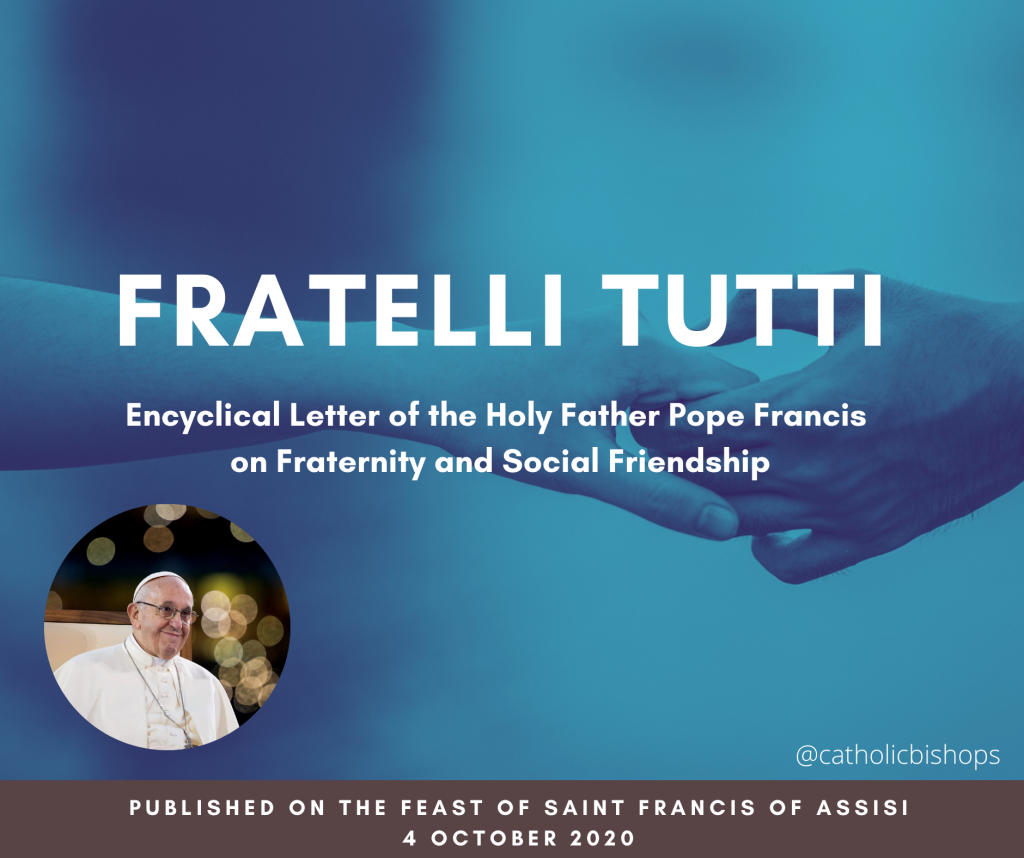
A few things have helped me stay grounded I recent times. First, I did much research, reflection, and prayer in preparation for an eight-week series on John of the Cross that I facilitated. Second, I found great wisdom in Pope Francis’ latest encyclical Fratelli Tutti. In it, he addresses some of the very issues we face today with wisdom from the scripture and Catholic tradition. Third, my reflection on the scripture for daily and weekday live-stream Masses keep me focused on Christ and his gospel. The gospels, particularly, often clarify my priorities, question my prejudices, challenge my preferences, and alter my perspectives. I have found wisdom in these things.
Solemnity of All Saints
The Feast of All Saints has a very long and interesting history. Whereas the exact origin of this feast is unclear, it is believed that it began organically at the end of the Christian persecution around 312 CE. Not only did the conversion of Constantine bring respite to the Christians but it also gave them the opportunity to look back and honor the martyrs and exemplars of faith. The church had a growing desire to honor the great number of martyrs, especially, those who were martyred during the long and brutal Diocletian persecution (303-311 CE). If the early church had to commemorate each of these martyrs individually, there would not be enough days in the calendar year. A common feast day for all saints, therefore, seemed appropriate, if not inevitable.
Thirtieth Sunday in Ordinary Time
When couples approach the parish for marriage preparation, they have to complete a pre-nuptial inventory form. One part of the inventory concerns the couple’s “spiritual assessment.” Among the questions in this segment is the question, “How do your religious beliefs influence the way you live your daily life?” Eight out of ten couples relate ‘religion’ and ‘being religious’ with treating others right, being good to others, not harming others and similar attitudes. And they are not wrong. However, that is only one aspect of religion, is it not? Today’s gospel reading is the passage I use to make the couples’ aware that there is more to religion that ethics and morality.
Twenty-ninth Sunday in Ordinary Time
Please click the image below for Fr. Satish's homily.