Fourth Sunday of Lent
The parish has always maintained its archives. Recently, the staff made a humungous effort to clean and organize it. But we have also begun something new. We have begun a book of chronicles. We have begun to record significant happenings of the week. The goal is that future generations can have an insight into the community in more detail that the bulletins provide. Hopefully when future generations read these chronicles, they will encounter not just an institution, an organization, or a parish, but a community of disciples – a community that thinks, talks, and acts like Jesus.
Today’s first reading is from the second book of Chronicles. Chronicles is a book of genealogy from Adam all the way up to until the proclamation of King Cyrus who ended the Babylonian exile. But Chronicles contains more than just a simple timeline. It is a theological book. It is a reconstruction of God’s intervention in human history. It is also a recording of the human response to divine intervention. And as tragic as it is, today’s passage (2 Chr 36:14-16, 19-23), does not make for pleasant reading. Today’s section says, “In those days, all the princes of Judah, the priests, and the people added infidelity to infidelity, practicing all the abominations of the nations and polluting the LORD’s temple which he had consecrated in Jerusalem” (2 Chr 36:14). What a shame! This should wake us up. What will the chronicles of the American Catholic Church say to the future generations? What will our parish chronicles look like decades from now? What will your story and mine sound like to future generations?
The Gospels are the chronicles Jesus. What an amazing life! It can be judged by the one purpose for which God sent Jesus - “God so loved the world that he gave his only Son” (Jn 3:16). Jesus dedicated his life to accomplishing the task which God entrusted to him. And this, at the cost of immense self-sacrifice. I am going to reflect on the gospel statement, “God so loved the world” using the chronicles of a 19th Century saint and a contemporary saint. In my third point I will offer a practical implication.
Thérèse of Lisieux
These days, I have been facilitating a six-week series on Thérèse of Lisieux. She came from a fairly privileged section of French society, grew up in an extremely loving family, and might be termed as a pampered child. But she always felt “little” and insignificant. She called herself the “little flower” of Child Jesus. Not only that. As she grew up, she suffered from terrible scruples in her spiritual life, often lacked consolation in prayer, experienced prolonged spiritual dryness, experienced unkind treatment from a few nuns in the cloister, and finally, after a prolonged and excruciating bout with tuberculosis, died at the age of 24. Before she died, under obedience, she chronicled her life. Her autobiography is titled, Story of a Soul.
One day, reading the New Testament as she struggled for meaning and purpose, she came upon the core of her vocation. When she discovered it, she exclaimed in pure joy, “My vocation is love! I have found my place in the Church!” Based on this discovery, she then opened a new path in Christian spirituality, “the little way!” It was simple, it was little, it was accessible. For her God’s love – the love we read about in today’s gospel reading – deserved only one response back – love. She described it as “Love for Love!” She loved Christ back like only a little child could. Then she translated this love into her relationship with her sisters. Not even ill-treatment would stop her from loving others in the most self-sacrificial way. That is the chronicle of St. Therese of Child Jesus!
Pope Francis
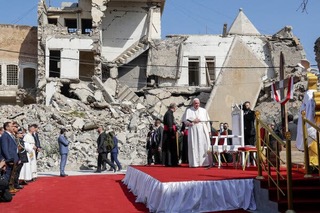
I now want to turn to someone I am calling, not lightly, a contemporary saint – Pope Francis. This weekend is the eighth anniversary of his election. Last week, Pope Francis was in one of the most dangerous places in the world. Amidst a pandemic, amidst sectarian and religious violence, and amidst the shadows of a controversial war, Pope Francis visited Iraq. Before he left the Vatican, he had a message for the people of Iraq. He said, “I come as a pilgrim, a penitent, and a peacemaker.” For me, there are two images that summarize his visit. This first one is in Mosul, the very place where some who opposed his visit said would kill him. But he had already said, “I come as a pilgrim, a penitent, and a peacemaker! He stood amidst the ruins as one who personified love – the love we read about in the gospel reading.
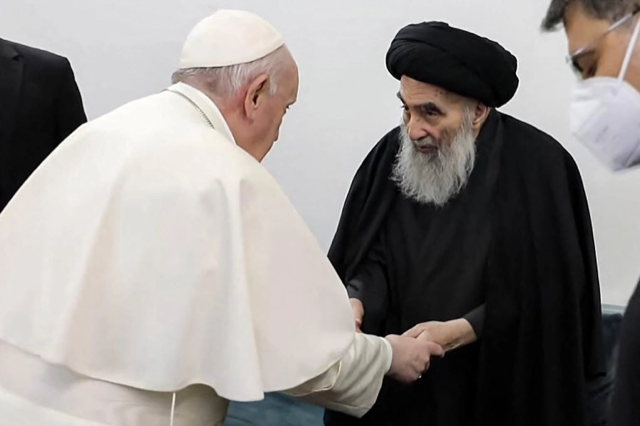
The second image is his meeting with Grand Ayatollah Ali al-Sistani. Islam and Christianity have been at odds for centuries. In the name of God hundreds of thousands have been killed. Hence Pope Francis said on his visit: “Anyone with the courage to look at the stars, anyone who believes in God, has no enemies to fight. He or she has only one enemy to face, an enemy that stands at the door of the heart and knocks to enter. That enemy is hatred.”
In recent times, Pope Francis has been emphasizing “fraternity” as the need of the global world. He sees Christianity as the force that has the power to create fraternal human bond. He truly believes, “God so loved the world that he gave his only Son…” For Pope Francis God’s love is not some abstract symbol. He truly believes that God’s love can be translated into a global policy. I predict this – that the chronicle of his life will be the chronicle of yet another saint.
Love for Love
It is now time to talk about us. In today’s second reading, Paul says, “God, who is rich in mercy, because of the great love he had for us, even when we were dead in our transgressions, brought us to life with Christ — by grace you have been saved” (Eph 2:4-5). Grace is not a one-way street. God’s rich and merciful love in Christ demands a faith-response. John describes this faith-response as, “…so that everyone who believes in him might not perish but have eternal life” (Jn 3:16). To believe is to respond to love, with love. To believe is to love like God loved. Thérèse calls it, “love for love.” She loved Pope Francis calls it “fraternity.” I call it “discipleship.”
I have only one practical implication for today. “God so loved the world that he gave his only Son” is the signature event of human history. Someday we will stand before God with the chronicle of our life. Like Thérèse of Lisieux, like Pope Francis, may our life story be the chronicle of a saint. May our life tell the story of love for love. May our life be a chronicle of human fraternity and of Christian discipleship. Every Lent is an opportunity to determine the direction that chronicle of our life takes.
Let me conclude with John’s gospel. Jesus said, “Just as Moses lifted up the serpent in the desert, so must the Son of Man be lifted up, so that everyone who believes in him may have eternal life.” At this Eucharist, the Son of Man will be lifted up one more time in the bread and the wine. As we receive Christ, may it be an expression of “love for love.” May this be the chronicle of our life. Amen.
- Fr. Satish Joseph