Friday of the Fourth Week in Ordinary Time
In today’s Gospel, we reflect on the beheading of John the Baptist. There are stark similarities between the imprisonment and death of John the Baptist and the passion of Jesus. Herod and Pilate are both fully aware of the holiness of John and Jesus. Each has the worldly power to set free or condemn. In turn, they both succumb to the pressures of their ‘peers’--Herod is influenced (through his disgusting lust) by the anger and resentment held by Herodias toward John, and Pilate by the hatred of the Jewish leaders toward Jesus. In the end, the innocent man is put to death for unjust reasons. Lack of justice–sounds familiar. We can point out many examples today where innocent people die at the hands of corruption, seething hatred, and evil. The imagery of the scene in today’s gospel and that of the passion of Christ are gruesome and vulgar. As I spend time with the stories, they become more unsettling each time I read them–just like stories about mass shootings, bombings of civilians, abuse of power by law enforcement and politicians, harmful treatment of children, and so much more.
Feast of the Presentation of the Lord
Today’s readings begin: “The Lord God said, ‘It is not suitable for the man to be alone. I will make a suitable partner for him.’” Let that first line sink in. It is not suitable to be alone – man, woman, child – we are not made to be alone. We are made to be in partnership, in community.
Jesus says to us in today’s Gospel, “A prophet is not without honor except in his native place and among his own kin and in his own house.” Jesus experienced the sting of offense as his “tribe,” the people of his hometown, rejected his teaching and his ministry. I wonder how many of us have experienced this same treatment when we’ve attempted to share the Gospel with those closest to us. Witnessing to friends and family can be very difficult. Perhaps today is a day to be enlivened, empowered, and emboldened to walk as Christ’s disciples and find our prophetic voice in our closest circles.
Memorial of Saint John Bosco, Priest
In today's Gospel reading we find Jesus healing two women. The first is healed because of her faith in Jesus through touching Him. The second is raised from the dead because of her father's faith in Jesus' ability to heal. One of the synagogue officials, desperate to save his daughter's life, turns to Jesus for help. The daughter is dead by the time they arrive, but Jesus raises her from the dead. It is Jesus Who has the power over life and death. This is because Jesus is God. But, as the church fathers were fond of saying, God became a human so that we might become gods. We do not really become "gods," but at our Baptism we do really receive the Holy Spirit, the third person of the Holy Trinity. God comes to dwell within us. In the Eucharist we do really receive Jesus completely, Body, Blood, Soul and Divinity. Again, God dwells within us. We are sanctified and elevated.
Monday of the Fourth Week in Ordinary Time
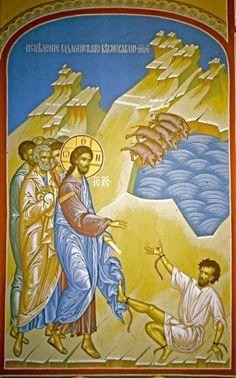
In one of the most graphic accounts in all of Mark, today we find Jesus on the far side of the Sea of Galilee, in pagan territory.
It is a strange and baffling tale. The possessed man is the most violent we meet in the New Testament, and is in the grip of a legion of unclean spirits. Yet this “legion” recognises who Jesus is and even “bows down before him.” Jesus expels them, ordering them into a nearby herd of swine to commit mass suicide, rushing headlong off a cliff into the Sea of Galilee. Greatly rattled, the locals ask Jesus to leave their territory immediately.
Memorial of Saint Thomas Aquinas, Priest and Doctor of the Church
Living with uncertainty is part of the human condition. We do not know what will happen tomorrow or even in the next hour. Most of the time we just continue to move forward in our daily routine not terribly concerned about what tomorrow will bring. Then something shocking occurs- an accident, a diagnosis of cancer, a pandemic. Suddenly the future seems unsure and there is an increasing worry about what will happen. In today’s gospel, Jesus reminds the disciples to have faith when situations arise that may be overwhelming. Jesus calls us to increase our faith in Him as well when we face challenges that seem insurmountable. Jesus desires us to trust in God’s love for us no matter the circumstances.
Friday of the Third Week of Ordinary Time
I think it's important to reflect deeply on the everyday stuff we often miss, or just really don't account for in our lives. I'm thinking here of how it took me a year to be able to do a particular pedal move on the organ; or how it takes a very slow, long time for my youngest to have learned how to draw. She was drawing chicken scratches; two years later she's drawing all kinds of amazing cows and ducks and superheroes that are actually recognizable.
Memorial of Saints Timothy and Titus, bishops
Today is the Feast of Saints Timothy and Titus. St. Paul saw both Timothy and Titus as spiritual children. In some way the shape of their faith and the positions they held within the church were a result of St. Paul’s ministry among them. They are both carrying on St. Paul’s ministry. In the first option for the first reading for today, from the Second Letter of St. Paul to Timothy, we catch a glimpse into another important means of carrying on the faith and helping the faith grow. In a line that is easy for many to pass over almost unnoticed, St. Paul writes to Timothy, “as I recall your sincere faith that first lived in your grandmother Lois and in your mother Eunice and that I am confident lives also in you” (2 Timothy 1:5).
Feast of the Conversion of Saint Paul, Apostle
“And so Paul was knocked on his arse,” I heard from our Irish monsignor when I was a kid. My parents would say, “get off your arse” or “you need a kick in the arse.” An Irish thing, I figured. Left over Gaelic. But the way our monsignor said it, “Knocked on your arse,” my ten year old self thought, “must not always be a bad thing.”
And Saul Paul of Tarsus’s arse was the most significant one to ever hit the ground.
Memorial of Saint Francis de Sales, Bishop and Doctor of the Church
Sisters and Brothers. These are probably not new words to us. If we come from a large family, they are part of our identity. Equally, if we have had a close friendship, it is as though the friendship is shaped into a bond just as strong as family; our friends become our brothers and sisters. Perhaps, even more importantly, these words are at the heart of our identity as part of the Church Catholic. We are more than a social group, more than people with common interests: we are a community of brothers and sisters, a family that is the Body of Christ.
Day of Prayer for the Legal Protection of Unborn Children
Those grandiose and bullying scribes are back at it. They accuse Jesus of being possessed by Beelzebub, stating that the “prince of demons'' gave him the power to cast out demons. Even Jesus’s own family comes to fetch him, to get him home, declaring him “out of his mind.” Maybe some warm chicken soup and a long period of rest will help snap him out of his delusions.
Memorial of Saint Agnes, Virgin and Martyr
Today is the memorial of Saint Agnes, Virgin and Martyr. While little is known for certain about her life, she died at a very young age, likely only twelve or thirteen years old. In the words of Pope Benedict XVI Saint Agnes gave, “…her young life totally and without reserve to ensure that the Gospel was proclaimed as the truth and beauty that illuminate existence.”
Friday of the Second Week in Ordinary Time
Simon, James, John, Andrew, Philip, Bartholomew, Matthew, Thomas, James, Thaddeus, Simon, and Judas; what do they all have in common? They are just ordinary guys. That, and Jesus summoned them on the mountain. In
today’s Gospel, Jesus goes up the mountain and names these men as his apostles. Up and down the ages, God has called ordinary people to faithful purpose. People like you and me. Can you imagine the internal wrestling for the disciples in this moment? My guess is that you can probably relate to the following mental commentary: “Who am I? I’m not anyone special. In fact, I’m pretty average. How could God use anyone like me?” God is extraordinary and uses us to accomplish great things in our world.
Thursday of the Second Week in Ordinary Time
In Mark’s gospel today, he lets us know that Jesus’ following is growing by a lot. And fast. He is attracting crowds not just from cities and towns in Galilee, but also from Judea and Idumea, some 130 plus miles south of Nazareth. They are also coming from coastal towns like Sidon, which is about 130 miles north of Jerusalem. And the crowds are big! They are so big, in fact, that Jesus has to get on a boat off shore to avoid being crushed.
Wednesday of the Second Week in Ordinary Time
In today’s Gospel, Jesus heals a man who had a withered hand. He performed this miracle in the synagogue, in the presence of the Pharisees. They couldn’t celebrate this miraculous healing because their hearts had withered. They could only experience the event with indignation and judgment, viewing it as a violation of sabbath laws prohibiting work. Today, I’m wondering, what in each of us has withered? In what way(s) are we in need of Jesus’ healing touch and restoration?
Memorial of Saint Anthony, Abbott
I love the next-to-last line in today's gospel (Mark 2:23-28): "The sabbath was made for man, not man for the sabbath." It proclaims so much about who we are and what God wants for us. In Genesis, God has a day of rest on the seventh day and in Jewish Law, all people were required to observe the sabbath. Here, Jesus is proclaiming that the sabbath was not made FOR God but God considers us so important and worthy of love, that we are the ones who are gifted with the sabbath.
Monday of the Second Week in Ordinary Time
In the time of Jesus, wine was stored in carefully prepared animal skins. As the wine fermented, the skins would stretch without bursting. But a wineskin couldn’t be used again because an old wineskin lost the ability to stretch. New wine required new skins.
Saturday of the First Week in Ordinary Time
Our society today promotes the concepts of individualism and self- sufficiency. I sometimes wonder if these attitudes are contributing to the decline in church attendance and the belief in God that many have noted in our nation. It is difficult to admit that we are broken and need assistance, but it is this very dying to self that allows us access to the mercy and grace of God. Today’s scripture readings remind us that we have a God that knows us, understands our weaknesses, walks with us, and offers both healing and wholeness if we will only acknowledge and accept this grace.
Friday of the First Week in Ordinary Time
“I say to you, rise, pick up your mat, and go home.” He didn’t say, rise, pick up your mat, and go celebrate, or even go tell everyone what I have done for you. No, he simply told the man who had been paralyzed for how long we don’t know to “rise, pick up your mat, and go home.” And he did. The gospel passage from Mark (2:1-12) tells us that the man whose name we do not know, “rose, picked up his mat at once, and went away in the sight of everyone.” And we read that it was so crowded in the home where Jesus was preaching that there wasn’t even room around the door to get in. Which is why this man’s friends, or maybe neighbors, broke through the roof to lower him who couldn’t walk into the room to get closer to Jesus. And we’re told it was their faith, not the faith of the man lying on the mat, that so impressed Jesus that he healed him.
Thursday of the First Week in Ordinary Time
I am a procrastinator by nature. So when I read today's first reading I get a little bit of anxiety. So much of this reading is focused on one word - "today!" Fellow procrastinators all know that today is not really when we like to do things. We prefer tomorrow or next week or next month. But Paul makes it very clear to us that when it comes to heeding the word of God, we are not to wait until tomorrow, next week or next month. We must act now. We must act today. If we hear God's voice today, we should begin to act today.