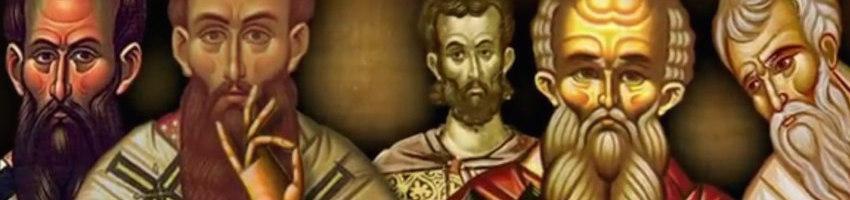
Memorial of St. Justin, Martyr
“In you, my God, I place my trust.”
The above refrain from today’s responsorial psalm (Psalm 91:2b) sums up the life of Justin Martyr (whose feast we keep today) and, in reality, all of the early Fathers of the Church. The early Christian Fathers are a gold mine in encountering the neophyte church in the first generations after the apostles.
Among them are Clement of Rome (30-100), Ignatius of Antioch (35-110), Polycarp of Smyrna (69-155), Justin Martyr (100-165), and Irenaeus of Lyons (130-202). In them we see how the Christian tradition began to take shape.
Justin is unique in that, as a Greek philosopher, he wrote a defense of Christianity to Emperor Antonius Titus. There were many popular half truths and outright lies about who Christians were. Among these were charges of incest (Christian couples addressed one another as “brother” and “sister”), cannibalism (eating the body and drinking the blood of a certain Christus), and a rejection of Greco-Roman gods, norms and citizenship.
What really stands out about Justin’s writings, for me anyway, was his description of the early Eucharist or mass. Outside of the New Testament, we get a peak at how our earliest ancestors in the faith celebrated the Eucharist. The writings of Justin influenced the renewal of the liturgy at the Second Vatican Council.
From the start, Christians understood our faith as “we” religion and not a “me” religion. This was particularly true of the liturgy which clearly was not a "spectator sport” but the action of all who assembled — a “we” and not “me.” On Sundays, local communities would gather in house churches. There they would hear the scriptures, celebrate the Eucharist and collect funds to distribute for the needs among them and beyond. No one had to be told that the Sunday gathering (in the Roman Empire it was a work day) was obligatory. They gathered (very early in the morning) because it was essential to their very identities, the very heart of who they were.
Of particular importance was Justine Martyr’s writings: “On the day called Sunday, all who live in cities or country gather together in one place, and the memoirs of the apostles or the writings of the prophets are read, as long as time permits; then, when the reader has ceased, the president verbally instructs and exhorts to the imitations of these good things. Then we all rise together and pray, and with our prayers, the people assent, saying Amen; Then bread, wine and water are brought forward, and the president offers prayers and thanksgivings according to his ability and the people affirm this by saying Amen and to those who are absent a portion is sent to them by the deacons.”
It is a great grace that the Eucharistic liturgy emerging from the renewal of Vatican Council so strongly imitates the description given by St. Justin Martyr!
—Timothy J. Cronin