Monday of the Fourth Week of Easter
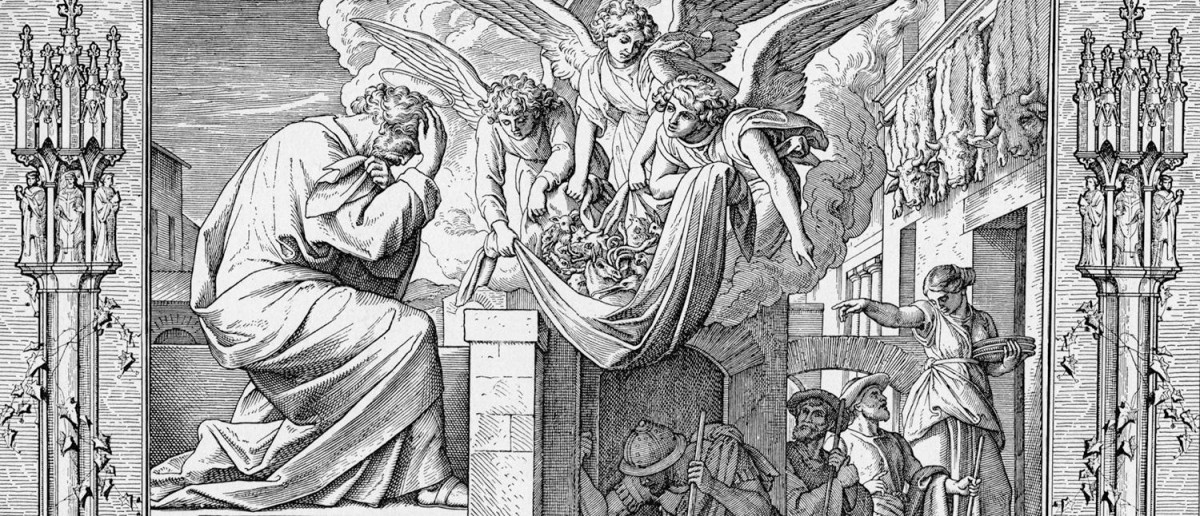
Today in Acts, in a startling vision, it is revealed to Peter that Jewish kosher laws are no longer required for followers of “the Way.” He is then summoned to Caesarea by “God-fearing” Roman centurion Cornelius. “God-fearers” were Gentiles attracted/drawn to Judaism and the Jewish God. Caesarea was the seat of the Roman governor, and a place filled with a wide variety of ethnicities, including some at odds with the Jews in both ritual and diet.
In Caesarea, knowingly breaking taboos, Peter enters the house of Gentile Cornelius. As the Spirit descends upon him, Peter discerns that “God has given repentance to life even to the Gentiles” (Acts 11:18). Cornelius and his entire household are then baptized.
This is a cautionary tale for any who would exclude others. Those who use arguments, lifted out of context from the Scriptures (never a good idea), to turn women or gays or foreigners or immigrants or liberals or conservatives or minorities or refugees or any other group into second-class members of the Body of Christ, are opposed to the God who in today’s readings expects otherwise.
An abhorrent example of this took place within our own Archdiocese not too long ago. Several members of an “unnamed” parish started a petition, supported by some on their Pastoral Council, that all Hispanics, before entering the church, must show credentials that they are in this country legally. Without this proof they may not enter the House of God.
Who would Jesus exclude?
In the Reign of God there can be “no partiality” and “no exclusion,” or put more bluntly by Peter, “Was I powerful enough to prevent God?” Exclusion in the church is not only a sin against the Holy Spirit, it is nothing less than taking on to oneself tasks that belong to God alone. Peter saw that he was “not powerful enough to prevent God” from including all. Quite simply, in the church of God, all are welcome, and all means all.
Who would Jesus exclude?
—Timothy J. Cronin