Monday of the Fourth Week of Lent
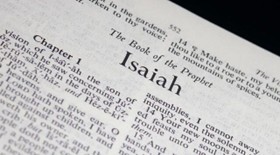
The prophet Isaiah is significant to our Advent and Lenten journeys. Many of us have been led to believe that prophets “foretell the future.” But in Catholic and mainline Protestant scholarship, prophets are seers of the big patterns; they see what is always and forever true. They are forthtellers and not foretellers.
The Book of Isaiah’s 66 chapters are divided into three parts (or three so-called "Isaiahs"): These sections were written at different times:
- Proto-Isaiah (Chapters 1–39): Prophecies of judgment, warnings for Jerusalem and messianic promises, attributed to the 8th-century BCE prophet Isaiah himself.
- Deutero-Isaiah (Chapters 40–55): The "Book of Consolation," written by an anonymous prophet during the Babylonian Exile (597 BCE-538 BCE), focusing on God's protection and the person of the Suffering
- Trito-Isaiah (Chapters 56–66): Another anonymous prophet wrote after 538 BCE and the return from exile, addressing challenges of rebuilding Jerusalem and the Temple. What we hear today (65:17-21) is from Trito-Isaiah.
It would seem that these three prophets (only the first one for certain called “Isaiah”) somehow got copied onto the same scroll in an ancient scriptorium someplace and sometime over the mist of centuries and became what was eventually passed down to us.
Each “Isaiah” has contributed so much to Christianity that the entire composition has been called “the Fifth Gospel” by the early Church Fathers. Richard Rohr writes, “Prophets [like Trinto-Isaiah] know how God acts by observing and listening, and so they embrace the wider truth or the 'bigger picture’ that is going on.”
One of the wider truths/bigger picture we learn from today’s readings is that God’s message always gets wider and more universal. So the prophets are not concerned with particulars (like “predicting” particular events) but speak rather of the patterns that are always true. It seems that the ancients had a wider awareness than we do. Maybe they were simply more patient, allowing the big pattern, of the way things always are, to unfold."
An example is found in today’s Gospel of the royal official who begs Jesus to heal his dying son. When the official returns home from his interaction with Jesus we have one of those rare examples of the healing of a non-Jew in Jesus’ ministry.
Rohr continues, “As it comes to be expected in the Gospels, it is inevitably the "outsider" who invariably ‘gets it…’ while the insiders defend smaller (and less significant) truths.” On paper the royal official deserves nothing. He checks very few boxes of the so-called “worthy” in the Galilee or Judea of the first century.
As an aside Rohr concludes, “One wonders how we ever made Christianity into a kind of exclusionary system when the vast majority of Jesus’ healings seem to happen to the excluded ones and even the unworthy ones.” This is the wider truth/bigger picture appreciation of this tale. The incidentals of the story are far less important than the universal truth at the heart of it.
What has been the wider truth for you that has been far more vital than any “incidentals?” What might some of these big patterns/big picture of what is always and forever true been for you?
-Timothy J. Cronin