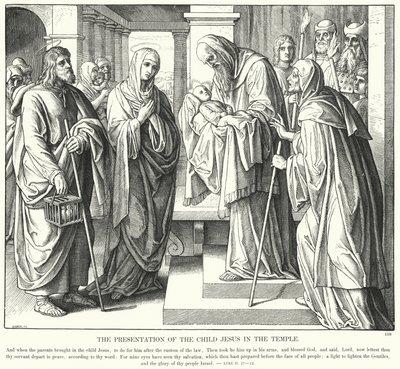
Feast of the Presentation of the Lord
As a kid growing up in the pre-Vatican II era, we referred to February 2 as “the last day of Christmas.” Since the reforms of Vatican Council II it is “the Presentation of the Lord” (and sometimes “Candlemas”). Now the Advent/Christmas cycle ends on the Feast of the Baptism of the LORD. Still February 2 commemorates the Holy Family as observant and obedient Jews, true to Mosaic Law.
Leviticus 12 mandated that mothers needed purification forty days after birthing a male child. Thus the feast is celebrated on February 2, or "Candlemas," is an allusion to Simeon's words about the child being "a light for revelation to the Gentiles" (Lk 2:32) – because the event takes place forty days after the nativity.
The mother was required to sacrifice a lamb or two turtledoves for those too poor. This is exactly what the Holy Family does in the narrative (Lk 2:24). Another precept of the Mosaic Law is the requirement that firstborns be consecrated to God (Ex 13:2). Thus the parents were expected to "redeem" (from the Latin redimō, meaning to "buy back") their child by paying five shekels as a Temple tax.
As such the Presentation was about: (1) the purification of Mary and (2) the redemption of the child Jesus. But the Mosaic Law nowhere demanded that the purification (or the redemption) take place within the Jerusalem Temple. Jerusalem was, after all, 90 miles from Nazareth through difficult and hostile terrain. Luke crafts his story for more theological than historical reasons.
Startlingly, there is one detail missing. While Luke does mention that Mary and Joseph bought the two turtledoves, he never mentions the paying of the five shekels to redeem the child. In other words, he cites the redeeming-of-the-firstborns precept laid down in Exodus 13:2, but he leaves out a description of this redemption taking place.
Pope Benedict XVI helps us understand, “In the Infancy Narratives, the answer is obvious. St. Luke leaves a literary silence in the passage in order to drive home the point that the infant Jesus belongs to his Heavenly Father. Evidently Luke intends to say that instead of being ‘redeemed’ and restored to his parents, this child was personally handed over to God in the Temple, given over completely . . . . Luke has nothing to say regarding the act of redemption prescribed by the law. In its place we find the exact opposite: the child is handed over to God, and from now on belongs to God completely” (p. 3 of the Holy Father’s book Jesus of Nazareth).
Understanding this helps us bring a new clarity to the fourth joyful mystery. The Presentation isn't just any ole’ ritual. On the contrary, it is a deeply symbolic moment pointing to Jesus' identity, and to Mary and Joseph's cooperation with his mission.
How do we, you and I, participate in that same mission, presenting Christ to the world?
—Timothy J. Cronin