Monday of the Twenty-seventh Week in Ordinary Time
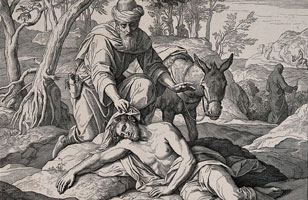
Our two readings today (Jonah & Luke) initially do not appear to have much in common. Upon further reflection they both narrow in on the dangers of tribalism which is currently running amuck and threatening the stability and unity of our land.
Jonah is a familiar story. Prophet of the God of Israel, he does not flee from the Holy One because he is afraid that the Assyrians will not listen to him. On the contrary, Jonah flees because he is afraid that Nineveh (Assyria’s capitol), will. The Assyrians were despised by the peoples of the ancient near east. Their reputation was of a cruel, sadistic and even soulless people. (Eventually all nations of the ancient Middle East joined forces to commit genocide against Assyria. You’d be hard pressed to find a descendant of the Assyrians alive in our world today).
Jonah desires that Assyria’s capital (Ninevah) be struck by the hammer of divine justice. No one deserved the mercy of God less than they. Such widespread and mutual hate existed, too, at the time Jesus told the Parable of the Good Samaritan in the tension between Jews and Samaritans.
Catholic writer/blogger Mark Shea writes of today’s readings in his blog "Catholic and Enjoying it:” If you want to get the hang of how the text sounded to the original audiences of Jonah & Luke, all you have to do is replace their despised outgroups (Assyrians & Samaritans) and cherished ingroups with our own.
To progressive American Catholics it could be the Parable of the Good ISIS Member and the people passing by the wounded man would be a progressive sister from the National Coalition of American Nuns and a liberal member of the Women’s Ordination Conference.
To conservative American Catholics it could be the Parable of the Good “Call to Action” member and passing the wounded man would be a Latin Mass Traditionalist and a member of the EWTN staff.
Were he telling it to a member of Black Lives Matter, it would be the Parable of the Good Klansman.
The point is that Samaritans (and Ninevites) were despised by their contemporaries and not without reason, just as some of our outgroups have done things to earn our disapproval. And yet Jesus demands that we look beyond tribal labels and see the individual person who is as loved by God as we are.
What type of “tribalism” do we identify with? Who is “on our side” and who is “on the other side?” Let us recall that every person we encounter is held close to the love and mercy of God, no matter their “tribe.” May tribalism itself meet the fate of the Ninevites!
—Timothy J. Cronin