Memorial of St. John Vianney, Priest
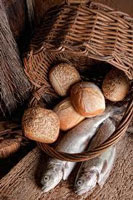
In the Gospels the miracles and parables of Jesus have one purpose — revelations of the Kingdom of God. Today in blessing simple food, Jesus reveals a great sign of that Kingdom.
From the smallest of portions we witness what our own Kingdom life ought to be. Even tiny offerings produce abundant results when placed in the service of the Kingdom. We must never downplay simple acts for the purposes of God.
But this Kingdom is not heaven “up there” but rather “right here.” We pray for its coming in the Lord’s Prayer, but sometimes miss it because the prayer is so familiar to us: “Thy Kingdom come on earth as it is in heaven.”
The story of the multiplication of the loaves is in the synoptics and John. That is a rare thing. In fact, in Mark and Matthew, Jesus performs this miracle on two separate occasions. The story must have had tremendous significance for the early Church. It anticipates the Eucharist in which we are fed by the incomprehensible generosity of God. God brings much out of little — the most common of foods, the simplest of foods – the most common of people, the simplest of people.
The Eucharist has been a defining element of Christian life from the get go. Today’s story teaches us that the more we give something away, the greater its effects.Thus we share in the Eucharistic action of Christ and assist in the task of Kingdom building.
We’ve emphasized over and over throughout the centuries WHAT the Eucharist is — the body, blood, soul, humanity and divinity of Jesus Christ. We have not done so well in teaching WHY it is. The Eucharist does not exist for its own sake. Once we eat and drink, then we become the monstrance, we become the tabernacle. We become the means by which the Lord is taken out into the world.
In the words of Cardinal Bergoglio that prompted the papal conclave to elect him pope in 2013:
“We have kept Jesus locked away. It is time to release him, to bring him out into the world.”
Eucharistic revival and Eucharistic adoration are wonderful things. But we mustn't leave Jesus in the monstrance or the tabernacle until “next time.” He longs to go out with us so that we might (in the words of St. Augustine) truly “receive what you are, and become what you receive,” for the building up of the reign of God.
-Timothy J. Cronin