Monday of the Sixteenth Week in Ordinary Time
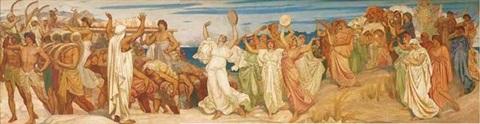
Our first reading today anticipates the well known parting of the sea in Exodus. Our Responsorial Psalm celebrates the event.
These writings are beloved of movie makers, providing spectacular cinema. The 1956 Cecil B. de Mille film The Ten Commandments thrilled audiences with the then novel visual effects that parted the Red Sea with walls of water rearing up and exposing the sea bed allowing safe passage for the Hebrews.
Scripture scholars debate the exact historical realities behind the accounts of the exodus and the journey to the Promised Land. Stories have been embellished and arranged in the narratives in order to emphasize their religious and theological significance. The biblical writers weren't concerned with strict history as we understand it in our western 21st century way of thinking.
As movies freely interpret historical events to suit dramatic purposes, the ancient authors and editors shaped their texts to make clear their meaning. It is the meaning that matters.
Among the scripture scholars who taught me all those years ago at Mt. St. Mary’s Seminary of the West in Norwood was Eugene Maly, a priest of our Archdiocese. Maly, who grew up in Cincinnati’s Price Hill neighborhood, was world renown and had taught scripture to the world’s bishops in Rome at the first session of the Second Vatican Council. A gentle and humble man, he was revered in the world of scholarship. We were in awe of him.
We seminarians would jest that Maly was present at the creation. We couldn’t “bs” him in our oral exams, try as we might. I remember his comment to me after I waxed on about the Gospel of Matthew. “I had never thought of it that way,” he said. I think he could hear my “gulp!”
I recall vividly our discussion in class of the exodus event and in particular the Song of Miriam at the Sea of Reeds (Red Sea). “I will sing to the Lord! He has covered himself in glory! Horse and chariot he has cast into the sea!” Maly told us this verse was the oldest oral tradition found in the whole of the Bible. He thought it probably went back to the event itself.
The exodus is so significant to salvation history that every chapter and verse of the Old Testament is saturated with it, including the creation stories themselves. It has been at the heart of the identity of every Jew throughout time, including a certain itinerant preacher Yeshua from Nazareth.
It is our task to be an exodus people, too. People of liberation and justice, for whom the worth of the individual person is of highest value — a people who welcome the destitute, the stranger, the disdained, the exile, the targeted, the scapegoated, the unaccepted — the heart of the commission of Yeshua himself. And the commission, in turn, that he has given to us.
—Timothy J. Cronin