Thursday of the Fifteenth Week in Ordinary Time
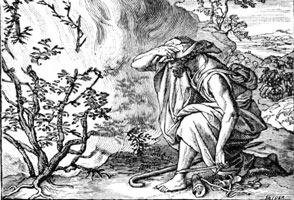
Then Moses said to God, “If I come to the people of Israel and say to them, ‘The God of your fathers has sent me to you,’ and they ask me, ‘What is his name?’ What should I tell them?” God said to Moses, “I am who I am.” And he said, “Say this to the people of Israel, ‘I AM has sent me to you” (Exodus 3:13-14).
Who gave you your name and why? For most of us our names are integral to who we are. Can we imagine having any other name than the one we have?
For the ancients, to know a person’s name was to acquire a certain power/control over them. Ritually speaking aloud the names of the gods of Egypt, Canaan, Greece, and Rome empowered the petitioner to formulate potions, magic, curses and blessings. Ancient deities and their supplicants had a relationship of mutual manipulation. “You scratch my back, I’ll scratch yours.”
This refusal to be named, by the eternal voice heard today in the desert of Midian, reveals that no name can capture who God is. God cannot be so limited as God is beyond limits .The Almighty does not have life, but is life. The Holy One simply IS, the uncaused cause.
Saint Anselm described the all-surpassing nature of “the uncaused cause” as “that which nothing greater can be conceived.” God is the fullness of all things. In Godself there is no before or after, no greater or less. We cannot even say that the Almighty “has” things, like wisdom or power, because God simply is goodness, truth, love, power, beauty and wisdom.
When Patriarch Moses asks the bush-that-would-not-be-consumed for the divine name in Exodus 3, Moses is prying about so as to know “what kind of being” God is, placing the Almighty in categorical terms. The patriarch thinks that Yahweh, the God of his ancestors, is like the gods he knew among the Egyptians. He learned very quickly this was not so.
“You scratch my back, I’ll scratch yours?” Our God will have none of it. Is this the kind of relationship that we have with God? God will not ever, no never, have such a relationship with his chosen ones. So what kind of relationship ought we have instead?
A covenant relationship — one filled with mutual respect, trust, and love. What form does that take for you?
—Timothy J. Cronin