Memorial of St. Kateri Takakwitha, Virgin
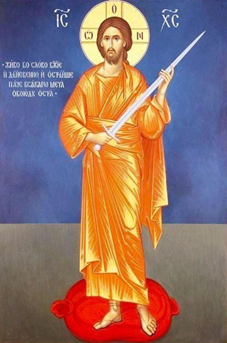
“Do not think that I have come to bring peace on the earth. I have not to bring peace but the sword” (Matthew 10:34). What are we to make of such a statement from Jesus?
Isaiah wrote that the Christ would be the “Prince of Peace.” Luke tells us that a choir of angels over Bethlehem announced his birth singing, “Peace on earth.” One of his Beatitudes is “Blessed are the peacemakers.” On that first Easter Sunday night, the Risen Jesus greeted his disciples with, “Peace be with you.”
When one of his disciples took up a sword to defend him on the Mount of Olives, Jesus rebuked him, "for all who draw the sword will die by the sword.” So what’s going on with him saying, “I don’t bring peace but the sword?”
Perhaps Jesus is telling his disciples that there will be conflict in his name. Many react with hostility to the Gospel both then and now. If taken seriously, the Gospel always threatens, always challenges the domination system of the day, and reverses the status quo.
Matthew’s audience in the 80s of the first century is readily identifiable in today’s account. Probably written from lower Syria to largely Jewish Christians, many from the original Jerusalem church who fled there with other Jews in the face of Titus’ destruction of the Holy City in 70.
Consternation and division seeped into the homes of that community. Family members who were followers of “the way” (who would eventually be called “Christians”) were expelled from their clans, from the synagogue, from the marketplace, from the life of the community. In order to understand the Jesus portrayed in Matthew, these circumstances and settings at the time it was composed must be realized from the start.
Although in a more subtle way, our faith is as rejected today as it was within Matthew’s community in 80CE. True, we aren’t getting thrown to the lions in the Circus Maximus anymore. But it is there.
Do we bend over to blend in? Do we make the values of this world our own? Is our faith only for Sundays? Do we claim the name of Jesus yet act and believe in ways contrary to the Sermon on the Mount? Or does the world consider us odd, obstinate, different? Do people shake their heads at our lifestyle such as refusing to get ahead at all costs or to amass more and more “stuff?
Back in the early 1980s I served on the staff of a large parish in a well-to-do suburb of Cincinnati. Our pastor touched a great many lives and was a suburb homilist. But he made it clear to his staff that we could have social justice topics or speakers but that he publicly would not support them. “People just get too upset by that sort of thing,” he told us. I appreciated his honesty and upfrontness. Needless to say I figured that wasn’t the place for me.
Can you imagine the Jesus of today’s Gospel backing off from his words because “people just get too upset by that sort of thing?”
Yes, courage is as needed today as it was needed in the last decades of the first century.
-Timothy J. Cronin