Thursday of the Third Week of Easter
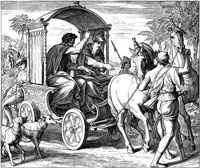
As we continue through Acts, the gospel spreads throughout Palestine. Today we hear of Philip and the Ethiopian eunuch. The eunuch was an important official in charge of the queen’s treasury. Men in charge of the harem were often made eunuchs (castrated).
Probably a Gentile who converted to Judaism, as a eunuch he would not be permitted full privileges at the temple. Traveling home from Jerusalem, he is reading from the scroll of the prophet Isaiah. He may have been drawn to Isaiah because the prophet writes about God’s acceptance of all, including eunuchs (Is 56:3-5).
Once again the Kingdom of God reverses the old law in favor of the despised, the unacceptable, those deemed undeserving.
For decades I taught scripture to the boys at St. Xavier. Whenever we would approach this section of Acts, they would universally groan at the reference to the eunuch. That was a sure thing. It would boggle their mind that sometimes a eunuch carried rights and privileges than those men who were, well, more “whole,” as it were.
Eunuchs are mentioned 50 times throughout the Bible (I looked it up). Nehemiah, the ultimate Jewish hero who would serve as the governor of Judah upon the return from Babylon, is implied in Nehemiah 2:6 to have been a eunuch.
“Becoming a eunuch for Christ” was how some perceived celibacy in the Middle Ages (for our first 1000 years clergy were permitted to be married in the Roman Rite). A man made law, celibacy remains debated today. Some say that it frees up clergy to give their entirety to the Church. Still, I think that ordaining the married would increase our ranks and be overall healthier for all concerned. Thus celibacy becomes an option as it continues to be in Eastern Catholic Churches and as it was in our Roman Rite for the first millennium..
Celibacy is a charism or gift of the Holy Spirit. I surmised that I didn’t have this gift so I left the seminary after 5 years, just prior to ordination. I still believe that my primary male archetype is “the priest” and I am as sure as I can be that I have that charism. Although I wouldn’t trade the married life I had or my family for anything in the world, it remains the greatest loss of my life.
—Timothy J. Cronin