Monday of the Third Week of Easter
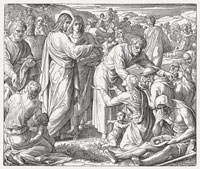
The familiar account of the feeding of the 5000 is one of the few to be found in all four Gospels. There are rich subtleties that, when missed, decrease our appreciation of what the evangelists wish to convey. In part this is because we aren’t as familiar with the Old Testament/ Hebrew scriptures as the original audiences did.
Here are a few subtleties:
- Barley bread – Unlike wheat bread it was cheaper, the bread of the poor.
- 5,000 people- multiples of 5 is the Hebrewic symbolic number for abundance.
- Jesus “takes and blesses” the loaves. This foreshadows the Eucharist.
John emphasizes the fragments — 5 barley loaves. In the “Didache (teaching) of the Twelve Apostles” (120 CE) we find the most ancient liturgical Eucharistic Prayer:
“We give you thanks, our Father… as this broken bread was scattered in the hills and then, when gathered, became one, so may your church be gathered from the ends of the earth…”
As Israel is reportedly “scattered” and then “gathered” throughout the Old Testament, so are the gathered people at every Eucharistic liturgy. Of note, this ancient Eucharistic Prayer uses the plural “we,” as have all Eucharistic Prayers since. For the entire gathered people is “a royal priesthood” (1 Peter 2:5). This is sometimes lost on Catholics.
It is always good to be reminded that the prayers of the Mass are all “we” prayers. We must never be passive observers at mass but full participants. This means singing all of the songs, responding to all the responses, and recognizing the full presence of Christ among the gathered assembly of worshipers.
While singing the communion processional hymn, I have made my prayer at communion time to look at the faces of the people of God as they return from receiving the Holy Eucharist. In those faces I see worry, faithfulness, brokenness, joy, doubt, struggle, sadness, happiness, serenity and more in a myriad of human faces, made in the image and likeness of God. Yes, even communion, although personal, is always communal. This is the faith community God has given us to be a part of so let us remember to respond with gratitude.
Yes, Christ is fully present in the Eucharist. But the Church teaches that Christ is fully present in the assembly of believers with whom we gather. He is not “kinda, sorta” present but fully present in them.
—Timothy J. Cronin