Monday of the Fifth Week of Lent
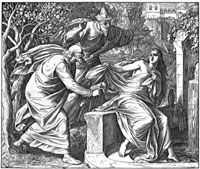
In today’s liturgy, young prophet Daniel interrupts the court railroading of Susanna by demanding that her corrupt judges be questioned — so as to prevent the death of an innocent woman. Daniel is one of the first figures in salvation history to promote rights for women. “As she was being led to her death, the LORD raised up the Holy Spirit in a young boy, whose name was Daniel (Dn 13:44).” In a way, Daniel prefigures Jesus as an advocate for women.
Perhaps not as well known today, the Susanna story was significant for the early followers of Jesus. Three frescoes of scenes featuring Susanna’s epic tale adorn the walls of the catacomb of Priscilla in Rome. Priscilla and her husband Aquila were essential to Paul in his ministry. Interestingly, Priscilla’s name is always listed first whenever the couple are mentioned.
In fact, one of the women who ministered to Jesus, Susanna, was named for the faithful and innocent heroine from Daniel. Other figures of the past such as Deborah the judge, Ruth the seeker, and Esther the queen modeled for the early church on how God inspires women to the divine purpose.
Our earliest New Testament writer is Paul. He was 20 years from the historical Jesus and nearly 20 years before the Gospels. Women were vital to the churches Paul founded. The Gospels, too, stress the egalitarian nature of the Kingdom of God movement.
Women were key players. Paul mentions Phoebe (Rom 16:1-2) as a deacon of the church. The word for her is “diakonos,” the same word used for his beloved Timothy. She wasn’t a “sort-of-deacon.” Junia (Rom 16:7) is “numbered among the apostles.” Later translations of Romans tried to masculinize her name. But the name “Junius” was unknown when Paul wrote his masterpiece letter to the Romans. Junia the apostle was a woman.
Luke especially promotes the instrumental contribution of women. Besides Susanna he lists Joanna and Salome among those who were in it for the long haul (8:1-3). That long haul included Golgotha. Salome assisted in preparing Christ’s body for burial and was one of the myrrh bearers who found an empty tomb on that early Sunday morning. Of course Mary Magdalene is the “apostle to the apostles.”
Women did not only assist in the Kingdom of God movement and the primitive church. They were in the forefront of it.
How is Susanna faring these days?
—Timothy J. Cronin