Monday of the Sixth Week in Ordinary Time
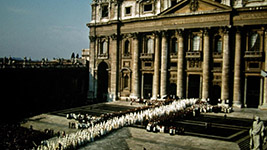
“Offer to God a sacrifice of praise” is our psalm response today (Psalm 50). This got me thinking back to how I have and have not experienced mass as “a sacrifice of praise.”
I was twelve years old when Vatican Council II concluded in 1965. So technically I grew up in the Church of the Council of Trent, the last ecumenical council. 1962-1965 and years immediately following were exciting as well as unsettling. The church, which “changes” at a snail's pace, was changing in leaps and bounds, week to week.
What happened is best summed up for me in comparing the first lines of the General Instructions of the Roman Missal:
GIRM before Vatican Council II: “Mass begins when the priest approaches the altar.”
GIRM after Vatican Council II: “Mass begins when the people have assembled.”
In the restoration of the liturgy the “congregation” went from the role of “audience” to that of “assembly.” We are no longer passive observers saying our private prayers but rather full participants, actors in the drama, gathered to do the work of our liturgy.
But how far have we come since 1965? There are strong winds blowing within the American Church that would like to scrap the liturgical renewal for a return to the mass of passive private prayer — the Eucharistic liturgy as something we “watch” rather than “do.” No longer “a sacrifice of praise.” But mass is not a spectator sport.
The 2000+ church fathers who gathered in October of 1962-1965 did not set out to find new fangled ideas and practices. Rather theirs was a mission to restore what was lost or fallen by the wayside over the centuries, where we “got off track.” In fact, how we “do mass” in 2025 is far closer to the experiences of the early centuries than the 16th century mass of Trent ever was.
In some ways the renewal has limped along over the past 60 years. One personal example for me has been in my role as a lector. The Liturgy of the Word is not “the Christian Science Reading Room.” It is not Bible Study. The proclaimed Word is an active and living word as Christ himself consoles and confronts us. It is difficult as a minister of the Word (lector) when so many are reading for themselves in missalettes. Unless one is hard of hearing, the lector, as minister of the Word, is where our focus ought to be (and lectors must work hard at their craft) as it is the lector at that moment who is the voice of the active and living Christ.
At the Liturgy of the Word our task is to worship with our ears. WE worship with our bodies as well as our minds. We worship as one Body of Christ. There are more such examples of where we still slip into passive rather than active roles at mass, where we “do our own thing.” Mass is always personal but it is never private.
Anyway, that’s my two cents.
Mass is a verb and not a noun. Mass is “a sacrifice of praise.”
—Timothy J. Cronin