Thursday of the Fifth Week in Ordinary Time
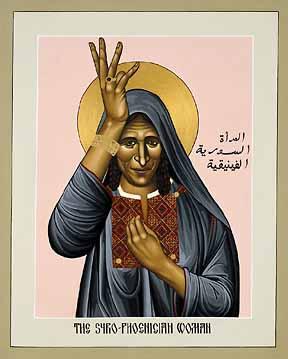
In today’s Gospel Jesus moves out of the territory ruled by Herod and into Tyre, a mixed district of both Greeks and Jews. Mark’s very human Jesus is a man of his time and place who saw the children of Abraham as the chosen people above all others.
The Syro-Phoenician woman will have none of it. She is unique among all the figures in the Gospels. She is the only one to win an argument with Jesus.
She begs the travelling rabbi/healer from the Galilee to heal her daughter. He tells her that he came for the children of Israel and not for the “dogs.” She counters that even the dogs get the scraps that fall from the table. In essence he uses the “b” word for both she and her daughter.
This is an astounding thing on so many levels. Women did not address a man unless he was a family member. Jews would hardly have made conversation with a Syro-Phoenician, least of all women. But we’re dealing with Jesus of Nazareth here.
What this brave lady does is she not only challenges but she stretches Jesus’s world view. As fully human he had to develop and grow as all human beings do. He is not God in a human disguise. He didn’t know all things in the manger at Bethlehem. Recall Luke’s words (2:51-52) about the twelve year old Jesus, “He went down with them and came to Nazareth, and was obedient to them (Mary & Joseph)... And Jesus advanced in wisdom and age and favor before God and man.”
The Gospels suggest that his approach to women was radical for the times. Luke tells us that “Following him were some women he had cured of infirmities, Mary called Magdalene… Joanna, the wife of Herod’s steward Chuza, Susanna, and many others who provided for him out of their resources” (8:1-3). It was women who kept the movement going. He was, as some Americans used to say scornfully, a “kept man.”
Sister Joan Chittister OSB writes,
“It is women who anointed him, and women who proclaimed him, and women who prepared him for burial…It was women, in fact, whom Jesus put at the very center of the only two mysteries of the faith—the Incarnation and Resurrection. It is a woman after all, who turned God into flesh.”
In the spirit of the Syro-Phoenician woman, may our Church call forth and respect the gifts of women to the same degree that Jesus himself did.
—Timothy J. Cronin