Monday of the Thirty-third Week in Ordinary Time
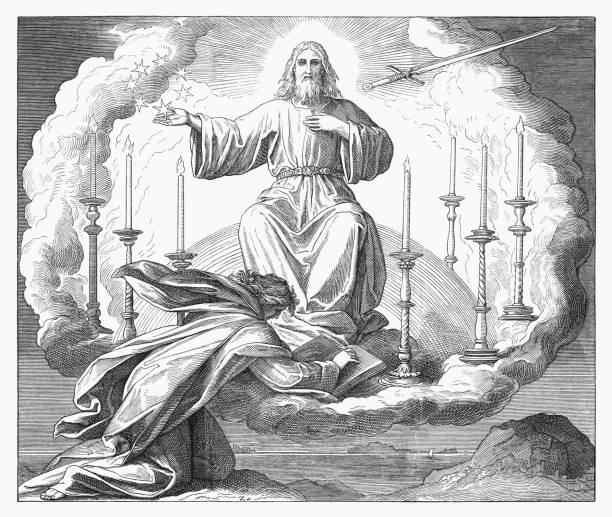
I love the Book of Revelation. It has inspired, consoled and supported me spiritually and financially. It put food on our table and paid our utilities. While teaching at St. Xavier, I offered Revelation as an elective and it grew so popular that I taught five sections every semester for twenty straight semesters.
I first encountered this book of hope in the ‘70s when I studied under Father Patrick J. Sena, CppS at Mt. St. Mary’s in Cincinnati. Sena was a creative and innovative teacher who’s techniques not only inspired seminarians but, as I discovered, were efficacious with teenagers, too. I'm sure that he is enjoying the Heavenly Throne Room first hand.
Today we hear the beginning of this apocalyptic work. With imagery from the Hebrew scriptures, non-biblical apocalypses, first century political circumstances, as well as Greek mythology, author John of Patmos weaves it all together to give hope for the righteous persecuted. Apocalyptic writing emerged among Semitic peoples from 200 BCE - 200 CE. Its concern is not predicting the future but rather with the struggle between good and evil in every time and place.
Beginning with seven letters to seven churches in Asia Minor, these seven cities were among the most loyal to Rome. Christians were tempted to compromise with pagan requirements such as dropping the designated pinch of incense before the standard of the emperor upon entering a marketplace. Emperor worship was the glue that held the Roman Empire together. Warnings against compromising with evil are at the heart of the book.
Like an underground newspaper using coded words that will confuse the civic powers but encourage the persecuted, nearly everything in Revelation is from somewhere else (especially Exodus, Ezekiel, Daniel, Enoch, and the War Scroll of the Dead Sea scrolls) woven together to create a masterpiece. True to all apocalyptic writing, everything is symbolic.
“Apocalypse” is ancient Greek for “uncovering that which was covered.” It does not mean, “Head for the hills. Jesus is coming and he’s taking names!” The best selling book of the ‘70s was “The Late Great Planet Earth” by Hal Lindsey. Also the ‘90s “Left Behind” series broke all records. These ignore first century literary form and manipulate the scriptures. Every generation thinks they are the most important and every generation thinks they are the last.
Taking the scriptures out of context is dangerous. As the great Bible scholar Cincinnati native Father Eugene Maly would tell us over and over again, we must always approach the Bible by seeing “Parts against the whole! Parts against the whole!”
The church of Ephesus is praised today for perseverance but condemned for losing their initial zeal. How might we apply this message to our own situations? Such application, rooted in the agenda of the original author and in the circumstances of the original audience, is exactly the point!
—Timothy J. Cronin