Monday of the Tenth Week in Ordinary Time
Mountains and hills dot the landscape of Palestine and are mentioned more than 500 times in the Bible. High places had a logical symbolism being “closer to the God who dwells in the heavens.” A mountain top was a natural place for theophany. God’s revelation was often on a high place. And such Old Testament references mattered a great deal, particularly to Matthew’s Jewish laden audience.
Matthew has six significant mountain scenes: Jesus’ temptation (Matthew 4:8), the Sermon on the Mount (Matthew 5:1-12), a number of healings (Matthew 15:29-31), the Transfiguration (Matthew 17:1), Jesus’ final discourse (Matthew 24:3), and the commissioning of the Twelve (Matthew 28:16-20).
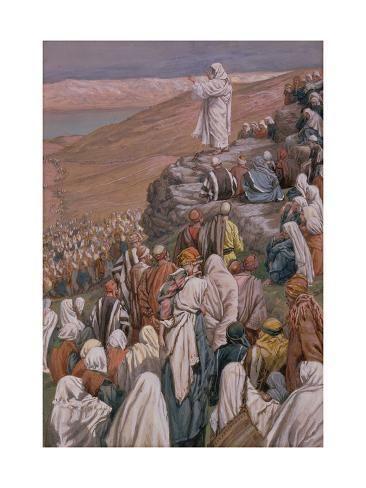
As we hear today, the new law, the law of Christ, finds its essence, its heart, its soul on the Mount of the Beatitudes, the new Mount Sinai of the new covenant. And our new liberator/law giver, Rabbi Jesus, teaches by his own authority, which Moses could not and did not do. (Matthew’s mostly Jewish community would immediately pick up on the comparison.)
But perhaps the most significant mountain scene is the Transfiguration of Jesus (Matthew 17:1-13), a theophany where Jesus appears with Moses and Elijah, who themselves encountered God on the mountaintop. Here Jesus is recognized as the fulfillment of the law (Moses) and the prophets (Elijah).
Where can we find our own theophanies? Dayton doesn’t have many “mounts” that I am aware of (the closest to our home is the top of the hill at Woodland Cemetery off Wyoming). Yet any place where we encounter the Holy One is a “theophany” and it may or may not be on a “high place.” After all, the theophanies of Abraham, Elijah, Isaiah, Paul and others were on level ground (in Luke’s version, the “Beatitudes” are preached on a plain). Our God doesn’t just dwell “in the sky,” but in all of creation, seen and unseen. God is all in all. What’s most important about theophanies isn’t where they happen but that they result in “metanoia,” which translates to “change of heart.” As Catholics we know that the greatest of all theophanies is in our celebration of Mass. And the mark of the efficacy of the liturgy is that people change — metanoia, as living and breathing flesh and blood beatitudes — from the sacrament of the altar to the sacrament of our neighbor.
Perhaps this is the best theophany of all.
—Timothy J. Cronin