Monday of the Third Week of Lent
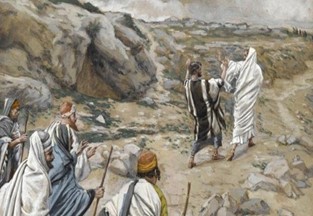
When the people of Nazareth heard Jesus they were filled with fury. They rose up, drove him out of the town, and led him to the brow of the hill on which their town had been built, to hurl him down headlong. But he passed through them and went away. Luke 4:28-30
We are so used to seeing Jesus as the face of the God of love that we forget that he was an agitator. This is especially true in our first written Gospel, Mark, who supplied the basis for Matthew & Luke.
In Mark, Jesus disrupts and unsettles. He is abrasive, agitating the rigid by bending/breaking mosaic law while encouraging his disciples to do the same. He rejects his own family, who wondered, along with the rest of his hometown, what was wrong with him. He challenged rock solid societal structures. Neighbors in tiny Nazareth attempted to kill him.
Many who heard him preach would have said, “Somebody’s going to kill this man.”
The Kingdom was the heart of his message and it was a threat to the powers that be. His was a kingdom of nobodies – powerless ones, the destained, those who dwelt in the shadows.
Egalitarianism was at its heart and its only hierarchy the wretched, the rejected and scorned. His Kingdom asks one question: “What would the world look like if God sat on Caesar's throne?”
Like Jeremiah, he assaults the Jerusalem Temple, the very heart of the Temple cult and Jewish identity, by questioning the very need for it. “The Kingdom of God is within you.” “The Kingdom of God is in your midst.”
Jesus is scary — “Better for one man to die than for the entire nation to perish.” The titulus above the cross accused him of a political crime and crucifixion was reserved for the likes of him in a time when there was no separation of religion and politics. Everyone within the Judaism of his day was religious, political, as well as apocalyptic.
He desired disciples who were as faithful and bold as he was, those willing to defend the defenseless and the weak and challenge the status quo in the name of the God of justice – those willing to turn the world upside down and inside out while envisioning the world as he did.
How are we doing?
-Timothy J. Cronin