Monday of the First Week of Lent
Matthew 25, as proclaimed today, teaches of the universal call to holiness that we all share by virtue of our baptisms.
When I was a kid, being just 8 years old when Pope John’s Council began meeting in Octobers of 1962 thru 1965, if you really wanted to be close to God, to be holy, then you either went to the seminary or entered the convent.
The church was a pyramid in those days, with the pope at the top followed by bishops, priests, deacons, and lowly lay people at the bottom (if there was room).
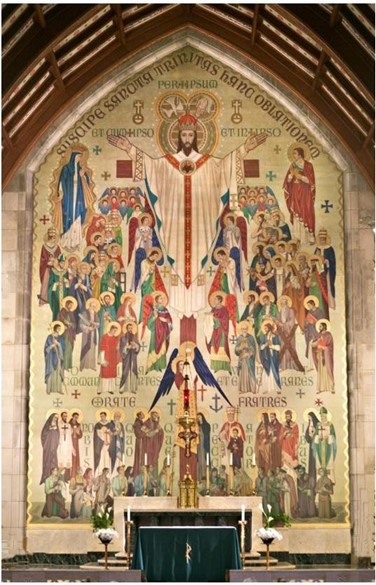
At Saint Anthony’s there is a beautiful mural, ceiling to floor, in the sanctuary of that magnificent church. It features the communion of saints. 60 saints surround a large image of Christ the King, all in glory.
Of the 60 there are only 10 lay saints: Mary & Joseph, Mary Magdalene, Perpetua & Felicity, Anastasia, Agatha, Cecilia, Maria Goretti, and Wenceslaus. Only the last two are not mentioned in the
Canon of the Mass (Eucharistic Prayer I), most from Roman martyrology.
At the very bottom, in smaller scale, are 20 mostly lay people seeking God here on earth, modeled by the lives of parishioners of the 1920s when the church was built: musician, seamstress, family of a father (a miller), mother of two children, policeman, doctor, firefighter, teacher and her boy and girl pupils, artist and wife, sailor, WAC, soldier, nurse, scholar, judge, student.
The central document of the Second Vatican Council was Lumen Gentium, the Dogmatic Constitution on the Church in the Modern World. At its heart is the call to universal holiness of all baptized Christians. Holiness is not exclusive to the “professional religious” (nuns and priests, etc.). Everybody is called to be saints.
If St. Anthony’s mural was painted nearly one hundred years later in 2024, what professions and roles of lay people might be featured? Possibilities include: web designer, chef, data scientist, physical therapist, software developer, transportation driver, psychotherapist, information security analyst, deacon, nurse practitioner, urologist, financial manager, home health care professional.
Five decades plus removed from the council that prioritized the universal call, they would be on equal scale with the mostly popes, bishops, priests and religious circling Christ the King above them.
What role or profession of ours might find its way to this mural? How do our lives reflect the universal call that we all share by virtue of baptism? How might this Lent offer opportunities to be better disciples in all settings and situations?
-Timothy J. Cronin