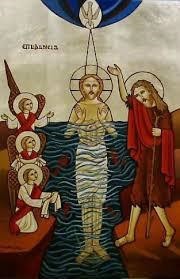
The Baptism of the Lord
The event at the Jordan is recorded in all four Gospels. To reach the place where John was baptizing, Jesus traveled 90 miles on foot from the Galilee. As the drama places the Baptist in a mentoring relationship to him, the evangelists wouldn’t have included the baptism of Jesus if it wasn’t historical.
Today we hear Mark’s account, the closest to the actual event, which is only four verses wherein the wildman immerser at the Jordan doesn’t protest at all. He simply baptizes this stranger from Nazareth. Here only Jesus hears the proclamation of the heavenly voice: “This is my beloved Son in whom I am well pleased.”
Nearly 20 years later, Matthew expands Mark’s version to six verses and the baptizer protests, “I should be baptized by you.” In Luke, the baptism is mentioned in passing, all the people hear God’s voice, and the Baptist is presented as Jesus’ cousin. By the time of the Fourth Gospel there is no baptism of Jesus at all. John simply points Jesus out to his disciples on the banks of the Jordan as “the Lamb of God.”
All of this illustrates how the writing and development of the Gospels was a gradual thing and that the early church grappled with the relationship between Jesus and John the Baptist.
Less than one hundred eighty years later, there was already an annual festival on January 6 to commemorate the Baptism of the Lord. Within her first five hundred years, the Church had developed the chain of celebrations of the Nativity, the visit of the magi from the east, the baptism at the Jordan, and Christ’s first miracle at Cana in Galilee.
All these festivals were called Epiphany, meaning manifestation. As we end the Christmas season today we might ask how this manifestation continues on.
As glorious as these solemnities may be, there is something very common and ordinary here. For you and I, numbered among the ordinary, this is a fine thing. It may be hard to see “theophany” in a stable for lowly animals and a newborn laid in a feedbox. Magi from the east, involving mad, murderous King Herod in their search, hardly appears to be about a divine plan. The Jewish peasantry at the Jordan don't exactly reveal divine manifestation. And the Galilean bride and groom at Cana were hardly Charles & Diana.
But they are epiphanies, all. St. Teresa of Avila wrote “God walks amid the pots and pans.” And in the words of President Lincoln, “God must like the common folk, having made so many of them.
Let us pray in this new year for sacramental eyes to encounter the manifestations of God in what the world might view as mundane. For in the lives of Christians there is no “ordinary.” God is ever manifest for those with eyes to see and ears to hear – sacramental eyes and ears.
-Timothy J. Cronin