Monday of the Twenty-ninth Week in Ordinary Time
Blessed be the Lord, the God of Israel, who has come to his people to set them free. He has raised up for us a mighty savior, born of the house of his servant David. Through his holy prophets he promised to save us from our enemies, from the hands of all who hate us. He promised to show mercy and to remember his holy covenant. This was the oath he swore to our father Abraham: to set us free from the hands of our enemies, free to worship him without fear, holy and righteous in his sight all the days of our life. Luke 2:29-33
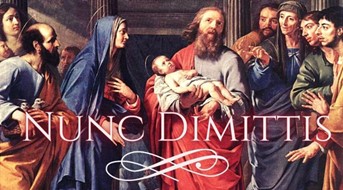
As an inheritance from the synagogue services of, in the words of John Paul II, “our Jewish elders,” we respond to scripture with scripture in our liturgies, usually with a psalm. However today our response to the 1st reading is not a psalm but the Nunc dimittis canticle from Luke. Simeon sings this at the Presentation of the Christ Child in the Temple.
It is evident from Luke that early Christians, like their Jewish forebears, sang the canticles of the Old Testament when they gathered to pray (there was no New Testament yet). Luke’s four canticles are based on canticles from the Hebrew scriptures. Indeed, this was (is) the way that Jews prayed and would have been familiar to Jesus of Nazareth.
Magnificat comes from Magnificat anima mea Dominum (“My soul magnifies the Lord...”), and Benedictus from Benedictus Dominus, Deus Israel (“Blessed be the Lord God of Israel...”). Likewise, the Gloria comes from Gloria in altissimis Deo (“Glory to God in the highest...”) and the Nunc dimittis from Nunc dimittis servum tuum, Domine (“Lord, let your servant depart...”).
From the very start these canticles have been sung by early Christians, adapted and reformulated from the Hebrew Bible placing them on the lips of Mary, Zachariah, the choir of angels over Bethlehem, and (today) Simeon. The Magnificat is sung at Vespers, the Benedictus at Lauds, and the Nunc Dimittis at Compline.
Praying the Liturgy of the Hours by lay and clergy alike was one of the restorations of Vatican Council II. Within our Family of Parishes, a group of inspired St. Anthony parishioners, through their own initiative, met in one another’s homes every Tuesday to pray the Liturgy of the Hours. Over a year ago they moved to the church and invited anyone who wished to join in.
Mary & I have tried to be faithful to this gathering. We have been warmly welcomed and the result has been a small faith community. We gather Tuesdays 7:00-7:30 pm. Attendees look forward to this prayer and shared reflection as an anchor, a highlight of their week. Such efforts harken back to the primitive church, singing the scriptures, especially the Psalms and canticles, as Jesus did. Like our earliest ancestors in the faith these folks welcome all to join with them, a half an hour in the midst of the week. Why not consider it?
-Timothy J. Cronin