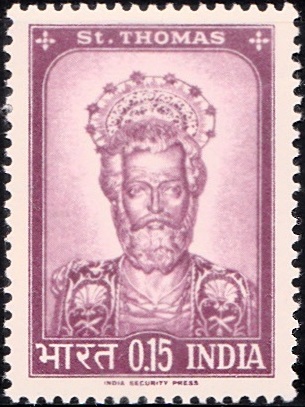
Feast of Saint Thomas, Apostle
A High School Religion teacher began the school year, as he always did, with a session on getting to know his students. Due to the nature of the class, it was apropos to inquire as to what faith the young men professed.
When a student of Indian descent responded that he was a Christian, the instructor asked if his family had been converted by European missionaries. “No, sir,” he replied. “We’re Thomas Christians.”
The teacher felt about two feet tall. That teacher was me.
Here I was an Irishman who traces his faith to the 4th century while this young man could point to the 1st century, and one of the Twelve.
According to tradition, Thomas the Apostle came to India in the year 52. Jews are known to have existed there in the 1st century. The earliest known source connecting the Apostle to Northwest India is the 3rd century Acts of Thomas.
A number of 3rd and 4th century Fathers of the Church also mention Thomas' trip to India, including Saints Ambrose, Gregory Nazianzus, and Jerome.
The Doubting Thomas story is recorded only in the Fourth Gospel. Here Jesus appears a second time in the Upper Room, showing his visible wounds - a wounded Savior greeting wounded disciples. He still bears the nail marks in his hands, and the spear wound to his side.
To be fair, Thomas doesn’t ask for something that the others hadn’t already received. One week prior, Jesus had displayed the marks of his crucifixion to the ten (minus Thomas). The first words of the crucified: “Peace be with you.”
Unlike the Risen One, we often struggle to hide our woundedness from one another, fearing them as signs of weakness. But for Jesus, his woundedness cannot and ought not be separated by his resurrection.
In that Upper Room, Jesus brought peace, breathed his spirit upon them, and commissioned them to do the same. In spite of his woundedness, in spite of our own.
Like the “Thomas Christians” (including our own pastor) who remained steadfast and true since the first century, may we do the same. Not despite our wounds, but because of them.
-Timothy J. Cronin