Monday of the Fifth Week of Lent
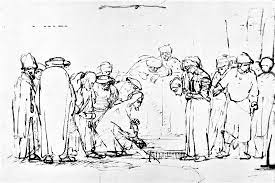
Today Jesus tells the mob surrounding the condemned woman, “Let those without sin cast the first stone.”
Then he bends down and writes on the ground, while the men drop their stones and disperse. But what did Jesus write on the ground?
According to Saint Ambrose, Jesus’s action was fulfilling prophecy: “The sin of Judah is written with a pen of iron” (Jeremiah 17:1).
In Jewish law, to convict someone of a crime, a priest would stoop down and write the law on the ground that the accused was being charged with breaking, and then adding the person’s name. Here Jesus is identifying himself as the one with authority to pass judgment.
Saint Augustine saw in Jesus’ writing an echo of God’s “writing '' the 10 commandments with his finger, thus establishing himself as a lawgiver, à la Moses.
It’s very important WHEN this act happens— the Feast of Tabernacles, a seven-day celebration only a few days after Yom Kippur (the Day of Atonement) when the scapegoat ceremony was performed. The people symbolically placed their sins on an innocent animal, then abandoned it in the desert to die.
During this time the water libation ritual was performed. The High Priest went to the Pool of Siloam filling a golden pitcher. Then he would then take it back to the Temple and pour it out, reciting the following verse from Jeremiah:
“O LORD, the hope of Israel, all who forsake you shall be put to shame; those who turn away from you shall be written in the dust, for they have forsaken the LORD, the fountain of living water” (Jeremiah 17:13).
More recently some have suggested that Jesus was writing down the sins of those ready to hurl the stones.
This action results in mercy for the woman. (Where is her male partner and why wasn’t there any attempt to stone him? “Boys will be boys?”).
The image of Jesus writing on the ground is one we can summon whenever we are tempted to “cast the first stone.” What does Jesus write on the ground when confronting you or I?
-Timothy J. Cronin