Monday of the Seventh Week in Ordinary Time
Jesuit theologian Karl Rahner wrote, “In the midst of our lives and our struggles we have to make a radical, absolute decision. And we never know when lightning will strike out of the blue. It may be when we least expect to be asked whether we have the faith and trust to say ‘yes.’”
To which we cry, “Lord, I believe, help my unblief!"
This lightning has struck in a big way. Much is demanded of each of us in these difficult times.
There is an exorcism of the entire Body of Christ happening as you read this. Pope Francis attempts to expel the demonic from out of our church. His deepest wounds have come from plots to undermine and sow division, some from within a segment of our American bishops and through a popular Catholic television network that has targeted him. This network claims absolute allegiance to the Chair of Peter (unless they don’t like the one sitting on it).
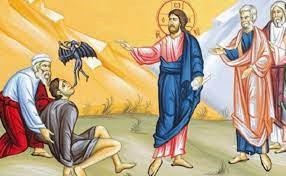
But the demon who resides within the bosom of the Church is not an ordinary unclean spirit but one which requires constant prayer to expel, as Jesus tells us in the Gospel today. It is diabolical, sinister, and insidious. It seeps into the nooks and crannies of the church. But Jesus gives us the formula that works. It demands constant prayer. And faith.
But what about our lingering doubts? We all have them. An American young man volunteered for one year with Mother Teresa and her sisters in India. It was his “gap year” between graduation from college and beginning his career. When his year was up, he said goodbye to Mother and asked, “Mother, pray for me.” “What would you like me to pray for you?” she responded. “I want certitude,” the young man answered. “I don’t have certitude,” she said. “I will ask that you be led to do God’s will.”
Faith and doubt are two sides of the same coin.
God is greater than all the demons in hell. Integrity and truth will win out. In the cross of Christ they already have. In our desire for faith we must continually petition our God for the grace to believe.
Frederick Buechner wrote, “In the end, ‘Lord I believe, help my unbelief,’ is the best we can do.” Perhaps this is the radical and absolute decision of which Karl Rahner wrote.
This mantra, “Lord I believe. Help my unbelief” bears repeating throughout life. And let us lift up in prayer our aggrieved and targeted Holy Father—himself a grace given to us for these perilous times.
-Timothy J. Cronin