Monday of the Thirtieth Week in Ordinary Time
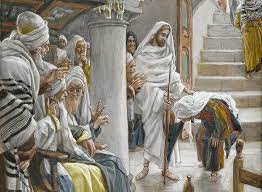
She was crippled and bent, robbed of her dignity and her rightful place in community. Unable to stand up straight, all she could see was the ground. After eighteen years, this daughter of Israel could hardly remember any other way of encountering the world.
Her place in the synagogue would have been in the shadows, if she was even allowed to enter at all.
Jesus is the face of the Father’s mercy. In Hebrew he is Yeshua Sar shalom, Prince of Peace (Isaiah 9:6). Jesus, who is shalom, graces this lowly daughter of God with a wholeness beyond comprehesion, both physical and spiritual well-being. Remember that the Judaism of the first century held that those who were disfigured must have sinned or their parents sinned or their grandparents sinned. Somebody sinned and so they suffered.
The feeble one is not only healed of her physical ailments today. She is reconciled to God. Her relationship with God restored – culturally that was something she could not experience in her diseased state. Yes, diseased equaled being dis-eased. In the first century physical ailments were signs of divine displeasure, denial of the shalom of God.
Shalom is more than just simply peace; it is contentment, completeness, wholeness, well-being, and harmony. It is heaven on earth.
This courageous woman’s restored shalom reveals the more serious dis-ease of the synagogue ruler. He is incapable of encountering a God acting out of compassion. God offers shalom to those who are ready to receive it. The handicapped woman was ready, but the synagogue ruler clearly was not. He is far more seriously dis-eased than she ever was.
Too many of us emphasize the magic in miracles, failing to see that they are firstly signs of divine restoration. And physical healing is not the most important thing that happens. Rather, the one who is cured participates in the shalom – resting in the very heart of God.
Miracles are not some divine magic act allowing the recipient to pursue interests as they had previously. It’s not a “Thanks, Lord. I’ll take it from here.” When the sacred breaks into the profane, relationship with God is restored. Otherwise it’s a failed miracle.
Miracles are signs of the Kingdom of God breaking into the here and now. Miracles are not in and of themselves the Kingdom, but rather they point to the Kingdom.
And in the reign of God that Jesus came to bring, the maimed and disfigured are first and the hyper religious are last.
In what ways are you and I dis-eased and in need of the intervention of the God who restores, the God who is shalom?
Timothy J. Cronin