Thursday of the Seventeenth Week in Ordinary Time
Wildman Jeremiah alerts Judah that they are on the brink of disaster unless they return to the promises they made with the God of Abraham, Isaac, and Jacob. The God of Sarah, Rebecca, and Rachel.
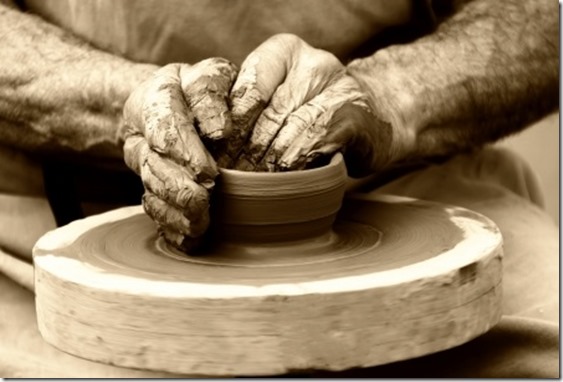
YHWH was semper fi in covenants made throughout salvation history with Noah, Abraham, Moses, and David. But alas, Judah falters again and again. So today Jeremiah illustrates the familiar image of the potter and his clay, to draw Judah back to the God who claims them.
The Divine Potter wants to reshape them as beacons to the nations. The Divine Potter’s intent is not to destroy those lovingly formed at the potter’s wheel, but to remold them in faithfulness.
Our Potter God intimately knows the clay, gently molded with divine hands. As the Psalmist declares: “For I am awesomely, wonderfully made.” But reshaping at the potter’s wheel is needed from time to time, so that Judah may walk once more with God in faithfulness.
Failure to act with mercy and compassion were signs to the prophets that Judah only gave lip service to the Holy One who had generously chosen them above all the peoples of the earth. Can you hear the Father beacon, “You are mine. I will not let you go.”
So how are we doing, you and I? We, too, are people of covenant contract. In what ways do we need to be recast on the potter’s wheel? For we the baptized, these questions must be filtered through the lens of that prophet of prophets, Jesus of Nazareth, and to the covenant of love he wishes to establish on the earth.
The measuring rod for Jeremiah and company was the state of the unloved, the rejected, those in the shadows. If those on the fringe were not treated with justice, then it was God who was being turned away. And so it is for we who claim the name of Christ.
How do we assess our fidelity to the covenant of Christ won by the blood of his cross? Here are some questions specific to our day and age rooted in what Jesus would have us do:
Who would Jesus deport? Who would Jesus execute? Who would Jesus deny health care? What kind of walls would Jesus build? How many assault rifles would Jesus distribute? How many homeless people would Jesus ignore?
As Jeremiah declares, “Turn back and mend your ways and your actions!” These are not simply words from the long ago past. They are reminders as fresh today as they were in the sixth century BCE. The Holy One desires our change of heart time and again.
If we are created in the image of God, then we too are potters and there is clay set before us ready to be molded as well.
What will we do with that clay?
-Timothy J. Cronin