Monday of the Twelfth Week in Ordinary Time
In today's liturgy we encounter a disaster with no parallel in salvation history---the total destruction of the Northern Kingdom (Israel) by dread Assyria (722 BCE). Only the tribes of Judah and Benjamin remain. Thus begins the legend of the “Ten lost tribes of Israel.”
For the ancients if something went awry it was because the gods were angry. This included personal losses and tragedies. Blind from birth? Struck with an unknown illness? Experiencing misfortune? You must have sinned or your parents sinned or your grandparents sinned.
That all sound so very neat, doesn't it? But whenever we encounter the Old Testament God of restitution we must, as I would advised my students over the years, “put on our Jesus glasses.”
What of the Ten Lost Tribes: Asher, Dan, Ephraim, Gad, Issachar, Manesseh, Naphtali, Reuben, Simeon, and Zebulun---all sons or grandsons of Jacob (Israel) as well as all their daughters and sons?
The 10 tribes were assimilated widely after being seized by Assyria. Nevertheless, legends persisted that one day they would return to the Promised Land. Among those claiming to be descendants of the Lost Tribes include Assyrian Christians, Mormons, Afghans, Ethiopians, Native Americans, Japanese, and groups of Jews in India.
Lands divvied out by landowner YHWH to the now lost tribes of Zebulun and Naphtali were located in what we now call Galilee. Isaiah claimed (9:1) that one day both would be restored there and Matthew sees that fulfillment in that Jesus came from Galilee (4:5).
The conviction that you suffer and I don't due to your unrighteousness persisted among God's people. But it is out right rejected by the Gospel. Jesus, depicted by Matthew as the new and improved Moses the lawgiver, warns against judging another. And none of us can presume to know the mind of God, an occupational hazard among Christians.
If the logic that bad things happen to those who deserve it was taken to its logical conclusion, then Jesus of Nazareth must have deserved his wrenched death. In fact, Deuteronomy 21:22 reads that “anyone hung on a tree (pole) is accursed.” Contemporaries of Jesus believed that he had been shunned and abandoned by God. If our God is righteous, they'd argue, then how could it be otherwise?
Tomorrow we remember Saint Aloysius Gonzaga, SJ (1568-1591). Gonzaga (the saint, not the basketball team) came from a powerful family, leaving prestige and wealth behind to join Ignatius Loyola's new Company of Jesus. Aloysius had considerable promise and was expected to contribute enormously to the new Jesuit order. But when a plague hit Rome in 1591 he cared for the most contagious and died at age 23. Was Gonzaga's misfortune because he had sinned?
We don't know why bad things happen. We just know that they do. God is incapable of only one thing---evil. But God does sometimes allows it. A teenage boy gets a newly minted driver's license and is killed by a drunk driver a week later. Innocents continue to be gunned down in our classrooms. Illness comes to working families with no health insurance. Newborns die from SIDS. Breast cancer. War crimes against defenseless civilians. And on and on....
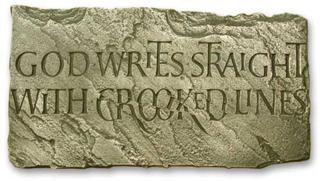
God is all good. God is love. When tragedies occur, God's heart is the first one to break. God weeps with us. And God can and does bring good out of evil, “writing straight with crooked lines.” Rabbi Harold Kushner's classic When Bad Things Happen to Good People is worth a read or re-read. And never be afraid to get angry with God. God can handle our anger. Persons in relationships get angry at each other sometimes.
The ancient question as to why good people suffer, sometimes called the “problem of evil,” is the entire theme of the Old Testament Book of Job.
The watchword here is mystery. Israel learned it. Job learned it. Jesus of Nazareth knew it. Aloysius Gonzaga experienced it. And so must we.
Good and gracious God,
Inspire us to hold on to you when bad things happen to us and to those we love. Help us to know you as a God who weeps with us. Help us persevere, O Lord. Make straight the crooked lines of our lives.
Timothy J. Cronin