Monday of the Fifth Week of Easter
At the turn of the last century a missionary society of priests and brothers, who labored on isolated islands in the south Pacific, sent their yearly report to their superiors. In part it read, “We have made some progress. Small steps, really. On Fridays the cannibals only eat fishermen.”
Missionaries Paul and Barnabas in today's first reading didn't face cannibalism on their first missionary journey but rather a far more familiar soul killing enemy--- flattery.
After healing a cripple, the people of Lystra confuse Paul and Barnabas with two popular Greek gods. They proclaim Barnabas as Zeus (Jupiter), patron of Lystra, perhaps because Barnabas was tall and handsome, like the head of the gods. Paul was called Hermes (Mercury), the spokesman of the gods, due to Paul's eloquence and short stature.
Stories circulated among the Greeks that sometimes Zeus and Hermes would visit in human form. At first, due to the unusual Greek dialect in Lystra, the apostles didn't realize that the citizenry was gathering to worship them. Even the priests of the great temple of Zeus were ready to sacrifice to the apostles. (This is the first time Acts' author Dr. Luke calls them “apostles.”)
It is a dangerous and tempting thing to be treated like a god. British Captain Cook “discovered” Hawaii, landing there in the eighteenth century. The Hawaiians were fascinated by the great ships of the expedition and Cook and his men didn't deny their supposed divinity, thus exploiting the natives. But later, when a supposedly “divine” crewman died, the Hawaiians turned on Cook and killed him.
Back in the '70s I was a seminarian in Cincinnati, studying for the Diocese of Youngstown. When I'd go home on breaks my family had suddenly become deferential to me. Back then, among the Irish, having a son, brother, cousin, or nephew a priest was the greatest honor imaginable. It made me very uncomfortable, not because I am above sin (hardly) but I knew I was still me, warts and all. And the last thing I could be was a pious walking holy card. When I left Mt. St. Mary's of the West after 5 years their expectations made it ten times harder both for them and for me. That was a rough time.
One of the gifts of teaching adolescents for 39 years was that they kept me humble. When I would get cocky or over confident in myself I'd fall flat on my face. Haughtiness or arrogance on the part of adults is abhorrent to teenagers. Guaranteed. (Although they could have a touch of hubris themselves.)
Paul and Barnabas reject such self glory. They tear (rend) their garments as a sign of outrageous indignation and they flee. They don't run away because of cowardice but out of prudence. “Flight,” according to St. Thomas Aquinas, is “prudence in action.”
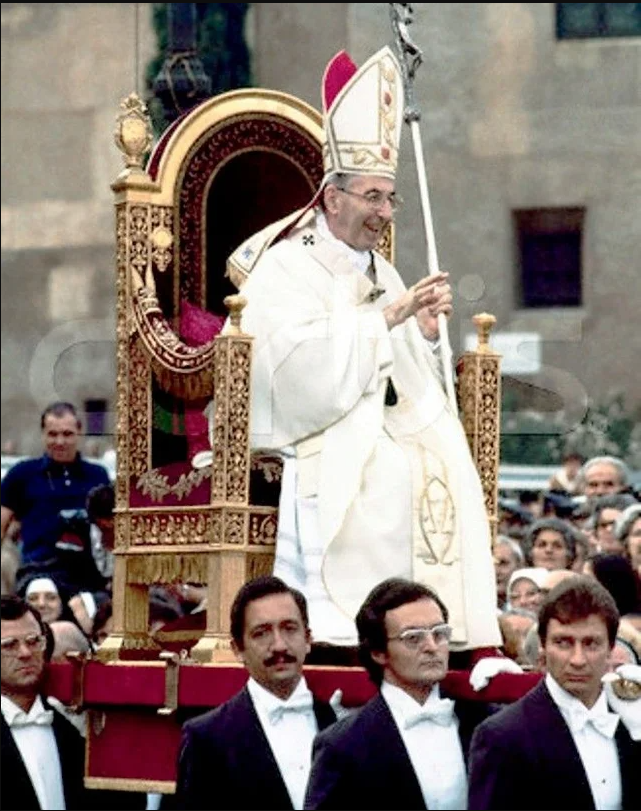
In the dark ages popes were nearly treated as gods. Being an earthy lot, Catholics seem to find ways to express truth with over the top, even macabre imaginations. Upon the death of a pontiff back then, his corpse was undressed of all his papal finery and laid out stark naked on a slab for all to see. In fact it wasn't until Albino Luciani (Venerable John Paul I) in 1978 that the Bishops of Rome stopped being carried aloft on the “sedia gestatoria” or high portable throne. (Its original purpose was so the faithful could see the Holy Father.) These days Pope Francis doesn't think twice about prostrating himself flat on the ground before warring world leaders, kissing their feet and begging them for peace.
Vanity and flattery can be traps for us as they were for the apostles. It may be good for us to comprehend the word “vanity” in its true sense---for vanity is vane. That which is vane is always false. Always. And when we are tempted by self importance may we flee with the swiftness of Paul and Barnabas. Or get down from whatever our version of the sedia gestatoria is, as Venerable John Paul I did.
Plus when you are up too high you are bound to get nose bleeds.
Timothy J. Cronin
(Even tough he was pope only 33 days in 1978, humble Venerable John Paul I will be proclaimed “blessed” by Pope Francis in a liturgy on September 4 in Rome. The “September Pope” is now one miracle away from canonization.)