Monday of the Fourth Week of Easter
In our reading from Acts, Peter has an earth shaking mystical experience. “Followers of the Way” (Christians) are no longer required to adhere to the 613 laws of Torah. Easter changed all that. “Who am I to hinder God?” Peter asks. Another way to put it, “God's thoughts are not our thoughts,” “God's ways are not our ways.” Peter's giant leap cannot be overstated.
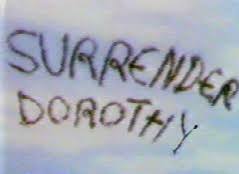
Like Peter, when we think that we have God figured out we can be sure that we don't. As popular culture may have it, “Surrender Dorothy!” (Back in the '90s it was a popular bumper sticker.) For today it's “Surrender Peter!”
And surrender Peter did. He's no longer a stumbling block or obstacle. And he doesn't just step aside, he gets on board.
Even “holy things” can become obstacles to God. The Church is not God. The Bible is not God. They are means to God but God cannot and will not be limited by them or by anything else.
How much of what we think God is about is simply a projection of ourselves?
Who can know the mind of God? But in pride we try. Pride is the root of all sin. It is the original sin. It is the deadliest sin. At its core pride is an attempt to be like God, the sin of Genesis. If the name of God is mercy, the name of Satan is pride. Today Peter sheds deadly pride. He rejects Satan and all his works.
Appropriately, Peter's startling vision occurred on the second Shavuot following the first Easter. Shavuot (Feast of Weeks) commemorated the giving of the Law at Mt. Sinai, 50 days after Passover, in Greek “Pentecost.”
The Feast of St. Nicholas, December 6, 1273, saw yet another indescribable vision of great consequence. After celebrating mass, scholar extraordinaire St. Thomas Aquinas had a taste of the beatific vision. At that the greatest mind in Christendom, in any time or place, was stilled.
There was no more dictation given to his secretary Reginald of Piperno. The saint told him, “The end of my labors has come. All I have written is mere straw. I can write no more.”
“The angelic doctor” tried to wrap God up in the safe blanket of logic, to incubate God in intellect. God will have none of it. The Almighty plays a cosmic joke on Thomas with a mystical “Come to Papa” moment. Surrender Dorothy? Surrender Peter? Surrender Thomas!
I've always admired the Greek/Eastern Church for having a far less compulsive need to define things as compared to our Latin/Western Church. Their experience of the faith seems to have a comfort level with mystery far greater than ours. They appear more ready to accept mystery than we do.
My Scots-Irish immigrant grandmother was the most single minded person I've ever known. She never read the Summa Theologica of Aquinas. She may have never heard of it. But in her simple devotional faith she had both Peter and Aquinas beat. The beatific vision was her life's passion for which she longed above all things. She didn't need to be shaken to the core by mystic encounters as Simon Peter and Thomas Aquinas did. She didn't need to be told to “surrender.” She already had.
Will we embrace the unfathomable mystery that is God?
Timothy J. Cronin