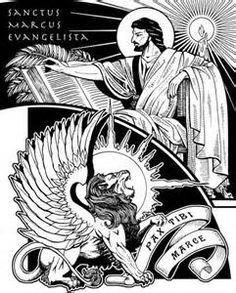
Feast of Saint Mark, evangelist
Ask people what their favorite Gospel is and you'll get a variety of responses, influenced by what that particular Gospel has that the other Gospels don't.
Some like Matthew for the Christmas star, the magi from the East, and the Flight into Egypt. Matthean Jesus preaches the Sermon of the Mount, on the new Mt. Sinai. He is Rabbi Jesus, the greater Moses, who fulfills the Law with the new law---the 8 Beatitudes.
Others prefer Luke, who features Mary with the Annunciation, the Visitation, the Presentation, and her glorious Magnificat. Popular parables are here, too, like the Good Samaritan & and the Prodigal Son. And we can't forget the journey on the road to Emmaus on that first Easter Sunday night.
Perhaps John is the most favorite. Jesus is the Word made Flesh who changes water into wine and raises Lazarus. Here we find the Good Shepherd, the washing of the feet, the Beloved Disciple taking Mary into his home, and Doubting Thomas touching the sacred wounds.
And then there's Mark.
Mark is sloppy Greek. Dangling modifiers? Confusing tenses? Run on sentences? Awkward construction? They are all friends of Mark.
Mark's Jesus is a wild man in a hurry, a rejected, abandoned, and scorned messiah. Everything happens “immediately.” It's like riding a roller coaster. Abrupt and rude, this is not sweet and gentle Jesus. And his disciples are utter nincompoops. Mark even manages to make Easter unsettling.
At the same time the author of Mark is one of the most influential writers in history, religious or otherwise. He invented the narrative literary form that we call “Gospel.” Of the four evangelists he brings us closer to the the primitive Church and to the world of Jesus of Nazareth.
But his original ending is the primary reason why Mark is my favorite.
It's ironic that the Church features the one part of Mark that he didn't write for proclamation on his feast day. His intended last line reads, “And the women ran away from the tomb and said nothing to anyone because they were terrified.” By the 2nd century, Christian scribes added what we hear today (16:15-20) because the original ending unsettled and confused them. But was that precisely what Mark wanted to do? It is true to the theme of his entire Gospel. It was true for the community for whom he wrote.
Mark's intended ending (at 16:14) is nerve-wracking and uncomfortable, and yet there is still that glimmer of hope--- He goes ahead of you into Galilee. That glimmer depends entirely on faith, a faith that relies on God alone.
It is not doubt that is the enemy of faith. It is fear. Fear is the culprit. Mark espouses the tension of faith vs. fear. Jesus refers to this time and again, “Fear is useless. What is needed is faith” (Mk 5:36).
Yet fear was a constant companion for Mark's original audience in the year 70. Jerusalem was reduced to rubble thanks to Titus and his legions. Christians suffered at the hands of mad man Nero in Rome. This is the setting. How can the Jesus of Mark be anything else than an intense, even wild man in a hurry?
The other Evangelists depict Jesus in inspiring and beautiful ways: The new Moses of Matthew, the compassionate healer/story teller of Luke, the soaring Incarnate Word of John.
But to me at least, Mark speaks of a Jesus more true to life's messiness, uncertainty, and struggles---the tension of faith vs. fear.
And then there's that glimmer of hope...
Timothy J. Cronin
Suggestion: Read Mark's short Gospel in its entity and on its own terms. Try as best you can to appreciate it apart from the other three. This is difficult to do as we tend to blend them together. But it is worth the effort.