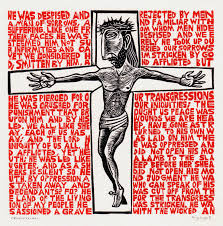
Monday of Holy Week
Here is my servant whom I uphold, my chosen one with whom I am well pleased. Isaiah 42:1
No more appropriate scripture could be proclaimed by the church at the start of Holy Week.
There are four “Suffering Servant Songs” from Deutero-Isaiah. We aren't sure who Isaiah is referring to as this famous Servant. Possibilities are Isaiah himself, the entire people of Judah, or a future messianic figure. The setting is the miraculous return to Jerusalem of Jewish captives from Babylon around 538 BCE.
Five centuries later the first Christians identified this suffering one with Jesus. And for over 1900 years this connection has been a way for us to touch the bruised face of the Messiah, the face of Jesus Christ.
Scholars contend that Mark, when he wrote the first known narrative Gospel, had a scroll of the prophet Isaiah open to Isaiah's Suffering Servant Songs as he composed his passion story. The shadow of the cross falls across Mark to such an extent that it has been called a “passion narrative with an introduction.” Even as early as chapter 3 we read of some who plotted against Jesus, wondering, “how they might destroy him.”
Mark's Jesus is tragic throughout ---rejected, misunderstood, reviled, assaulted, abandoned, tortured, condemned. But “by his wounds we are healed.” At the climactic scene at Golgotha, Mark has a Roman centurian--- a pagan, a non-believer, a Gentile, an executioner—make the astounding act of faith that has alluded everyone else, even Jesus's close disciples and his own family: “Truly this man was the Son of God.”
Holy Week comes around every year to invite those who have grown weak or dim to receive anew the Servant's healing touch. “Who could fail to recognize the suffering Christ within the contours of the Servant's face?” (USCCB)
This “chosen one” has a painful destiny. “God's Spirit sent him to heal and strengthen the weak, to mend and restore the hearts of all who are losing hope or have been cast aside by the rich and mighty” (USCCB). He comes not to condemn the weak of heart but to invite them into the Kingdom of God's justice and grace.
As we move thru Holy Week and experience once more the abandonment, arrest, condemnation, beatings, and crucifixion, let us keep in mind that ultimately God vindicates this chosen one.
The rich imagery of the “Suffering Servant Songs” lead to many questions. Here are some offered by the US Catholic bishops for us to to ponder:
- Why do you think suffering is so often a reality for God's chosen ones?
- What parts of you are “bruised” or “dimly burning?”
- Are you distant from God or open even more to merciful grace because of you weakness?
- Like the Servant of YHWH how might we strengthen the weak and oppressed we encounter?
- What stirs within you when you observe innocent suffering?
- In your own pain do you feel like you suffer alone or does Christ suffer with you?
Timothy J. Cronin